
Interesting Dao
Conflict Resolution Through Daoist Dialogue
Oct
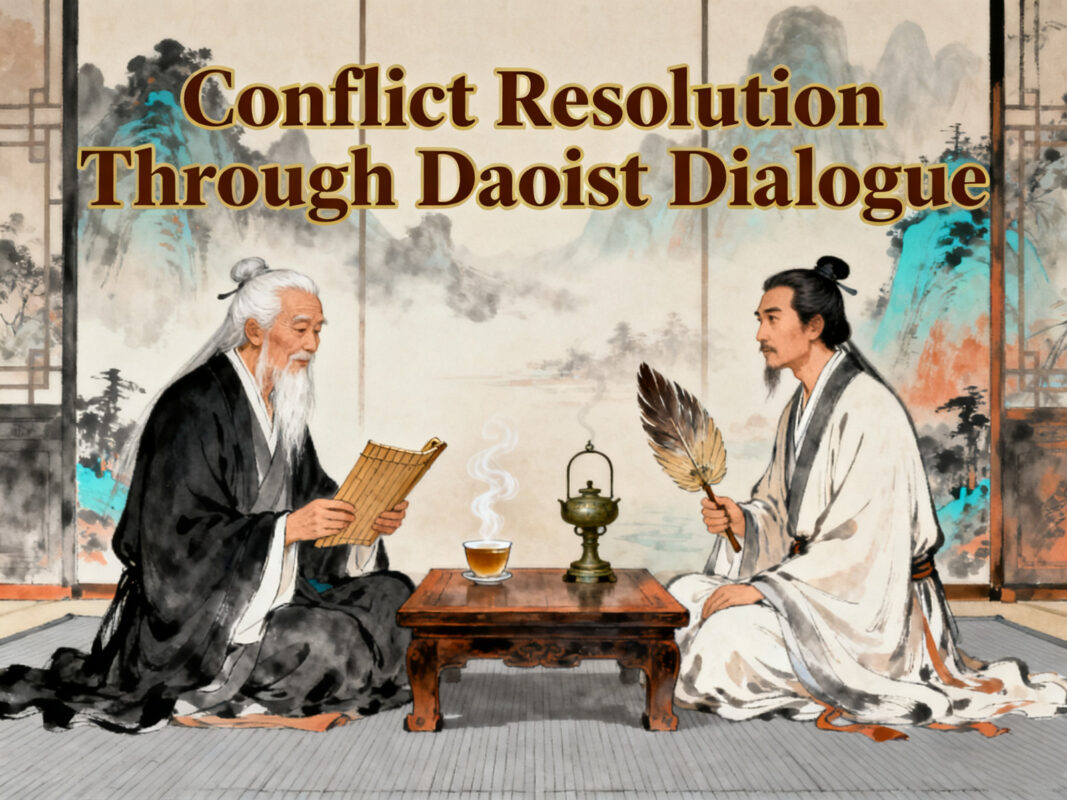
Conflict Resolution Through Daoist Dialogue
In every society, conflict is inevitable. It arises between individuals, groups, and even within the self — the friction between what is and what one wishes it to be. The modern world, characterized by speed, competition, and polarization, magnifies this tension. Conventional conflict resolution frameworks tend to emphasize control, negotiation, and compromise — all of which assume a linear process and rational actors. Yet, reality is rarely linear, and human beings are rarely purely rational. In this complex landscape, Daoist philosophy offers not merely an alternative method but a radically different perspective — one that values harmony without force, understanding without dominance, and communication that flows like water.
This post explores how Daoist dialogue, rooted in the principles of Dao and wu wei, can serve as a model for resolving conflict with wisdom, balance, and authenticity.
1. Understanding Daoist Foundations in Human Interaction
Daoism, emerging from the teachings of Laozi and Zhuangzi, does not propose rigid moral systems or prescriptive codes of conduct. Instead, it focuses on the dynamic balance of life, the spontaneous flow of existence, and the art of aligning oneself with the Dao — the Way. To understand Daoist dialogue, one must first grasp these foundations.
The Nature of the Dao
The Dao is not a doctrine or a deity; it is the underlying order of all things, the subtle pattern that connects opposites and allows contradictions to coexist. To follow the Dao in human relationships means to recognize the constant interplay between yin and yang, softness and firmness, speaking and silence. A Daoist approach to conflict begins with awareness — not of positions or arguments, but of the flow of tension and release between two beings.
Wu Wei and Non-Interference
Central to Daoist thought is wu wei, often misunderstood as passivity or doing nothing. In truth, wu wei means acting in accordance with natural tendencies, responding appropriately to circumstances rather than imposing willful control. In conflict resolution, this translates to listening before speaking, observing before judging, and seeking movement rather than victory. The Daoist mediator does not force outcomes but allows clarity to emerge through the gentle unfolding of dialogue.
2. The Essence of Daoist Dialogue
Daoist dialogue differs fundamentally from debate or persuasion. It is not a contest of intellects but a process of mutual transformation. Its aim is not to win but to harmonize.
Listening as Flow
In Daoist dialogue, listening is not a passive act; it is an attunement. Just as a musician tunes to the resonance of another instrument, the Daoist listener aligns with the emotional and energetic rhythm of the speaker. When one listens with openness, without preconceptions or defensive barriers, the other naturally softens. This softening does not indicate defeat but creates a shared space where new understanding can arise spontaneously.
Speaking from the Center
The Daoist way of speaking mirrors the qualities of water — gentle, adaptable, and persistent. Words are chosen not for their persuasive power but for their clarity and resonance. Speaking from the center means speaking without attachment, letting truth express itself naturally. This is why the Daoist dialogue is often slow, punctuated by pauses and silence. The silence is not emptiness but a form of communication — a space where meaning settles and insight ripens.
The Circular Nature of Understanding
Unlike the linear structure of Western logic, Daoist reasoning often follows a circular or reflective path. It does not aim to reach a conclusion but to restore equilibrium. When two people engage in this kind of dialogue, they begin to see the relativity of their perspectives. Conflict loses its rigidity, becoming instead a dynamic dance of opposites, much like the turning of yin and yang. This transformation of perception is itself the resolution.
3. Applying Daoist Principles in Modern Conflict Resolution
While Daoist philosophy originates in ancient China, its applications in modern interpersonal, organizational, and intercultural conflict are profound. By reorienting the process from confrontation to harmonization, Daoist dialogue reframes conflict as an opportunity for balance and growth.
In Personal Relationships
In personal disputes — between partners, friends, or family members — emotions often surge faster than understanding. A Daoist approach begins with slowing down the rhythm of communication. Instead of reacting, one breathes. Instead of defending, one listens. The key practice is non-resistance: allowing the energy of anger or hurt to move through without clinging to it. When both parties engage with this awareness, they stop trying to prove who is right and begin to sense what is real. Reconciliation arises not from concession but from shared insight into the situation’s impermanence and interdependence.
In Workplaces and Leadership
Modern workplaces thrive on efficiency and decision-making, often leaving little room for stillness. Yet, many organizational conflicts stem from miscommunication and ego-driven assertion. A Daoist leader or mediator cultivates wu wei in decision-making — creating conditions for others to express freely without fear, guiding discussion with minimal interference. The leader’s role is not to impose a resolution but to help participants rediscover their own alignment with the greater purpose of the group. This process mirrors the Daoist view of governance: leading by not leading, influencing by being aligned rather than authoritative.
In Cross-Cultural or Ideological Disputes
Daoism, with its fluidity and tolerance of paradox, offers a framework for bridging cultural and ideological divides. Instead of forcing synthesis, it encourages appreciation of diversity as complementary expressions of the same whole. In cross-cultural dialogue, adopting a Daoist stance means resisting the urge to simplify differences into hierarchies or binaries. It invites curiosity, humility, and flexibility — seeing in each viewpoint a fragment of the Dao rather than a threat to one’s own truth.
4. Practices to Cultivate Daoist Dialogue
Daoist dialogue is not a technique to be memorized; it is an inner orientation cultivated through mindful practice. Several methods from Daoist tradition support this cultivation.
Stillness and Observation
Before engaging in dialogue, cultivating inner stillness allows one to observe thoughts and emotions without becoming entangled. This self-awareness creates a clear mirror, reflecting the other person’s energy without distortion. When the mind is still, reactions dissolve, and genuine responsiveness becomes possible. Even a few moments of silence before speaking can transform the tone of an entire conversation.
The Practice of Returning
Daoist texts often speak of “returning to the root.” In dialogue, this means returning repeatedly to the essence of what matters — beyond ego, beyond justification, beyond the story of who is right or wrong. When conflict escalates, one can pause and inwardly ask, What is this really about? What are we both seeking? Often, beneath anger lies a desire for recognition, safety, or connection. Returning to this root brings the conversation back to sincerity.
Embracing Paradox
A hallmark of Daoist thought is comfort with paradox — accepting that opposites coexist and can both be true. In conflict resolution, this ability dissolves rigidity. Instead of choosing between opposing viewpoints, the Daoist mediator helps both sides see how each contains the seed of the other. This does not erase differences but transforms them into complementary forces. Harmony is achieved not by eliminating tension but by recognizing its necessity.
The Art of Letting Go
Perhaps the most profound aspect of Daoist dialogue is letting go of control — trusting that the process itself will yield clarity. Just as a river finds its way to the sea without effort, human understanding deepens when not constrained by the need for immediate resolution. Letting go does not mean indifference; it means faith in the natural intelligence of human connection.
5. The Transformative Power of the Daoist Perspective
What makes Daoist dialogue revolutionary is not its exoticism but its realism. It acknowledges the messy, fluid nature of human experience and works with it rather than against it. In a world obsessed with speed, achievement, and certainty, Daoist communication reintroduces patience, humility, and empathy as instruments of transformation.
From Resolution to Harmony
Most modern conflict models aim for resolution — a clear end point, an agreement signed, a problem “solved.” Daoist dialogue shifts the focus from resolution to harmony. Harmony does not mean uniformity or permanent peace; it means dynamic balance. Just as waves continue to move even in calm waters, human relationships evolve through cycles of tension and release. When harmony becomes the goal, conflict is no longer an enemy but a teacher — a signal pointing toward imbalance that calls for adjustment.
The Ethical Dimension
Daoist dialogue carries an implicit ethics grounded in respect for life’s interdependence. To speak and listen in the Daoist way is to honor the dignity of all participants, to act without coercion, and to trust in the wisdom of natural order. This ethical orientation transcends legalistic morality; it is spontaneous, responsive, and compassionate. It invites one to see the other not as an opponent but as a mirror — reflecting what one has not yet understood within oneself.
Relevance in the Modern World
In global politics, social discourse, and even digital communication, polarization has become the norm. The Daoist model of dialogue offers a path toward reconnection — not through argument or enforcement, but through the cultivation of shared presence. Whether applied in diplomacy, therapy, or community mediation, the Daoist principles of wu wei, balance, and listening restore a sense of humanity to conversation. They remind us that understanding grows not from power but from humility.
Conflict resolution through Daoist dialogue is ultimately a practice of returning to what is natural in us: the ability to listen deeply, to respond authentically, and to coexist in difference. It teaches that peace is not a fixed state but a rhythm — one that can only be sustained when we move with the flow of the Dao, not against it.
When dialogue becomes fluid, when words arise from stillness rather than fear, even the most entrenched conflicts begin to soften. What remains is not the victory of one side over another but the quiet recognition that, beneath our differences, the same current moves us all.