
Dao Book Introduction
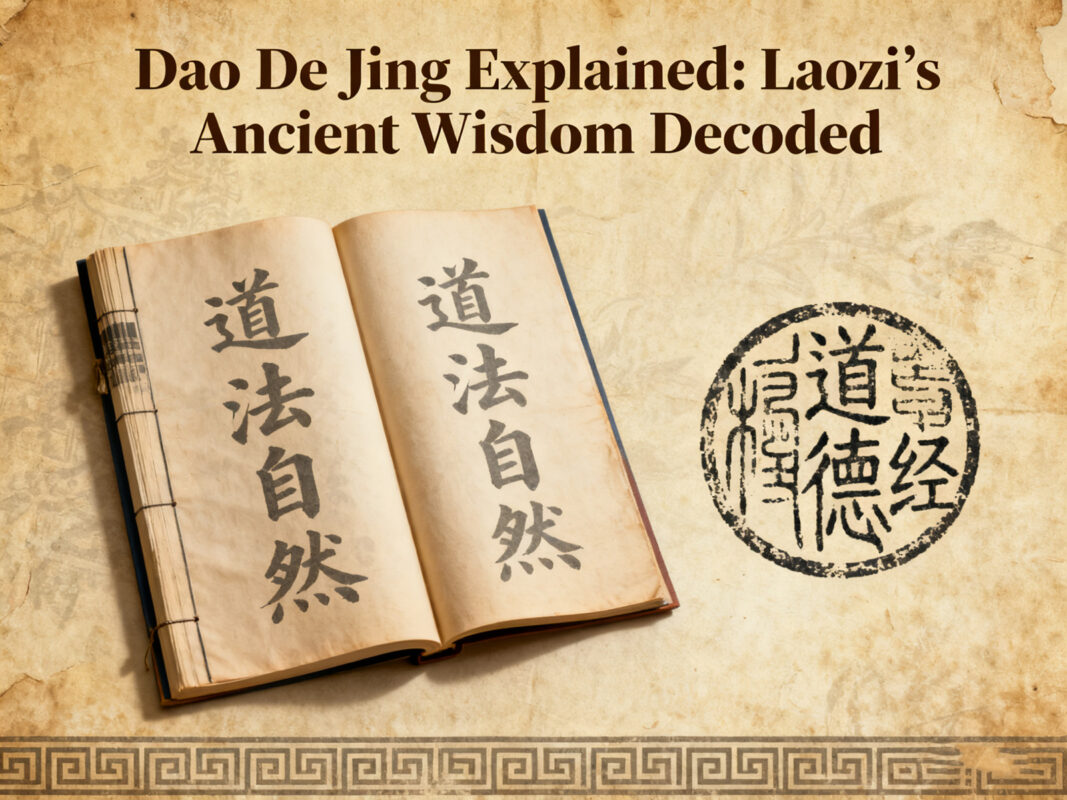
Dao De Jing Explained: Laozi’s Ancient Wisdom Decoded
Nov
Dao De Jing Explained: Laozi’s Ancient Wisdom Decoded
More than two thousand years ago, an old sage riding a water buffalo paused at the western border of ancient China, where a gatekeeper asked him to write down his wisdom before he departed into the mountains. The brief manuscript he left behind — about five thousand Chinese characters in total — became the Dao De Jing, one of the most translated and studied texts in human history. Its author, Laozi, remains an enigmatic figure, part philosopher, part myth, and part poet.
The Dao De Jing endures not because it offers clear instructions but because it teaches how to live with clarity when the world itself is unclear. Its verses, poetic and paradoxical, invite reflection rather than argument, insight rather than doctrine. Across centuries, readers have turned to this work for guidance on governance, ethics, personal balance, and the art of letting life unfold in harmony with the Dao — the ineffable Way that underlies all existence.
To decode this ancient text is not to pin down a single meaning, but to explore how its timeless principles — simplicity, non-interference, humility, and naturalness — remain relevant in a modern world driven by speed, ambition, and control.
1. The Mystery of the Dao: Naming the Unnameable
The Dao De Jing opens with one of the most haunting lines in world literature:
“The Dao that can be spoken is not the eternal Dao;
The name that can be named is not the eternal name.”
From its very first verse, Laozi warns that language cannot capture reality’s essence. The moment we define the Dao, we have already limited it. The Dao is not a concept, a god, or a law; it is the underlying rhythm of the universe — the spontaneous order that gives birth to and sustains all things.
The Dao Beyond Words
In Daoism, the Dao represents the source of all being and non-being, a cosmic process rather than a fixed entity. Everything arises from it and returns to it, just as waves rise and fall within the sea. Trying to describe it is like trying to pour the ocean into a cup — whatever we say about it will always be incomplete. This is why the Dao De Jing relies on paradox, metaphor, and imagery instead of definitions. The Dao is known through experience, not explanation.
The Principle of Return
Another key concept Laozi emphasizes is return — the movement of all things back to their origin. This cyclical rhythm governs life, nature, and even the moral order. “Returning is the motion of the Dao,” he writes. Growth and decay, success and failure, gain and loss — all belong to a greater balance. Understanding this rhythm brings serenity, because one sees that change itself is natural. Instead of resisting impermanence, the sage flows with it.
In this sense, the Dao is not something to be found but something to be remembered. It is the pattern of reality that we obscure when we overthink, overreach, or overcontrol. Laozi’s wisdom begins with recognition of limits, the humility to accept that the universe is wiser than our attempts to manage it.
2. The Power of Wu Wei: Action Through Non-Action
Among the most profound and misunderstood ideas in the Dao De Jing is wu wei, often translated as “non-action.” To modern ears, this might sound like inaction or passivity, but in Laozi’s teaching, wu wei means acting in perfect alignment with the natural flow of things. It is effortless effectiveness, the art of doing without forcing.
Acting Without Forcing
When Laozi speaks of wu wei, he is not suggesting that one withdraws from life. Instead, he describes a mode of action that arises spontaneously, without struggle or ego. Like a skilled dancer who moves without hesitation or a craftsman who works with instinctive grace, the Daoist sage acts from stillness, not from tension. “The softest thing in the world overcomes the hardest,” Laozi writes, comparing this gentle power to water — flexible, yielding, yet unstoppable.
This teaching has deep practical relevance today. In a culture obsessed with productivity and control, wu wei reminds us that real strength lies in timing, intuition, and restraint. Pushing against the natural course of events often creates friction and burnout, whereas aligning with it allows outcomes to unfold organically.
Leadership Through Wu Wei
One of the most remarkable applications of wu wei appears in Laozi’s chapters on leadership and governance. “The best rulers,” he says, “are those whose existence the people barely know.” Such a ruler leads not by force or decree but by presence and example. By creating conditions in which people can flourish naturally, they rule through non-domination.
This insight remains timeless: whether in politics, business, or family life, influence grows stronger when it does not impose. The Daoist leader trusts in the intelligence of the collective, allowing harmony to emerge rather than attempting to engineer it.
3. The Virtue of De: Inner Power and Integrity
While the Dao represents the cosmic order, the term De (often translated as “virtue” or “power”) refers to its manifestation within individuals. To possess De is not merely to act morally but to live in a way that reflects the Dao’s natural harmony.
De as Inner Radiance
Laozi describes De as a kind of inner resonance, the quality that arises when a person lives in simplicity, humility, and sincerity. When one acts without ego, without striving for recognition or control, one’s presence itself becomes powerful. The person of De influences others not through persuasion but through authenticity. “The highest virtue is not virtuous,” Laozi says, “and therefore it is virtue.”
This paradox points to an essential Daoist insight: true virtue is effortless. It is not a product of moral willpower but of natural alignment. When the heart is at peace, compassion flows naturally; when the mind is uncluttered, right action arises without calculation. De is therefore not something to acquire but something to recover — it is already within us, obscured only by desire and distraction.
The Decline of De in Society
Laozi laments that when the Dao is lost, people turn to artificial substitutes — laws, morality, and rituals. “When the Dao is lost, there arises virtue; when virtue is lost, there arises benevolence; when benevolence is lost, there arises righteousness; when righteousness is lost, there arises propriety.” Each step represents a decline from natural harmony toward external control.
In modern terms, we could say that as authenticity diminishes, societies rely more on rules, appearances, and systems of enforcement. The Dao De Jing invites a return to simplicity — to trust, empathy, and self-restraint as the foundation of genuine order.
4. Simplicity, Softness, and the Art of Living
If the Dao De Jing could be distilled into one practical message, it might be this: live simply and trust the natural flow of life. Laozi’s philosophy, though ancient, speaks directly to the modern condition of complexity, anxiety, and overextension.
The Beauty of Simplicity
Laozi teaches that simplicity is strength. “Manifest plainness, embrace simplicity, reduce selfishness, have few desires,” he advises. The more we chase after possessions, recognition, or control, the more restless we become. True freedom comes not from accumulation but from letting go.
Simplicity is not about poverty or denial; it is about clarity — the ability to distinguish what truly matters from what distracts. In personal life, this might mean valuing quiet moments over endless activity; in leadership, it means focusing on essentials rather than micromanaging every detail.
The Strength of Softness
One of the most recurring metaphors in the Dao De Jing is water. Water is soft and yielding, yet it wears down stone; it seeks the lowest places, yet nourishes all things. Laozi repeatedly uses water as a model for the Daoist way: humble, adaptable, and unresisting. “Nothing in the world is softer than water,” he writes, “yet nothing is better at overcoming the hard and strong.”
In practice, softness means flexibility — the capacity to adapt without breaking. In conflict, it means responding rather than reacting. In relationships, it means empathy instead of domination. The paradox of softness is that it is not weakness at all; it is resilience disguised as gentleness.
The Wisdom of Emptiness
Equally central is Laozi’s praise of emptiness. “Clay is shaped into a vessel,” he notes, “but it is the emptiness within that makes it useful.” Emptiness represents openness, potential, and the space through which creativity flows. In both mind and environment, leaving room for emptiness allows renewal. When we fill every moment, every thought, every schedule, we leave no space for the Dao to move through us.
To live according to the Dao De Jing is therefore not to withdraw from the world but to engage it with spaciousness — to create room for silence amid noise, rest amid motion, and stillness amid change.
5. Laozi’s Legacy: Ancient Wisdom for a Modern World
It is remarkable that a text so brief, written in an age without modern science or global communication, continues to influence philosophy, politics, psychology, and art across cultures. The Dao De Jing endures because it speaks to something elemental in human experience — the tension between control and surrender, ego and humility, complexity and simplicity.
Influence and Interpretation
Over centuries, the Dao De Jing inspired emperors and monks, poets and revolutionaries, scientists and spiritual seekers. It gave rise to Daoism as both a philosophical school and a spiritual path, emphasizing harmony with nature and the cultivation of inner stillness. Beyond China, its influence can be seen in Zen Buddhism, minimalism, ecological philosophy, and even leadership theory.
Each translation and commentary reveals a new facet of its meaning. Some emphasize its political dimension — a guide for rulers on how to govern without oppression. Others read it as a manual for personal transformation, mindfulness, or ethical living. What unites them all is the recognition that Laozi’s wisdom transcends context because it speaks to the underlying patterns of life itself.
Modern Relevance
In today’s fast-paced, hyperconnected world, the Dao De Jing offers a counterbalance to constant striving. It reminds us that clarity comes from quiet, that progress sometimes requires patience, and that the most effective action often feels effortless. In leadership, it teaches that trust and humility create stronger teams than authority alone. In personal life, it suggests that contentment arises not from acquiring more, but from needing less.
When we read Laozi today, we are not merely studying ancient philosophy; we are engaging in a dialogue across millennia about how to be human in a world that never stops changing. His verses whisper a message that feels startlingly contemporary: let go of the obsession to master life, and instead learn to move with its rhythm.
The Dao De Jing is not a manual to be followed line by line but a mirror that reflects our inner state. Each reader finds in it what they are ready to see. For some, it is a political treatise; for others, a spiritual poem. Yet beneath all interpretations lies a single invitation: to live with awareness, humility, and trust in the greater flow of existence.
Laozi’s words remain as relevant now as they were on that dusty frontier long ago — an ancient voice reminding a restless world that the deepest wisdom is often the simplest: the Way that can be followed is not the true Way, yet it is always present, waiting quietly within us.