Interesting Dao
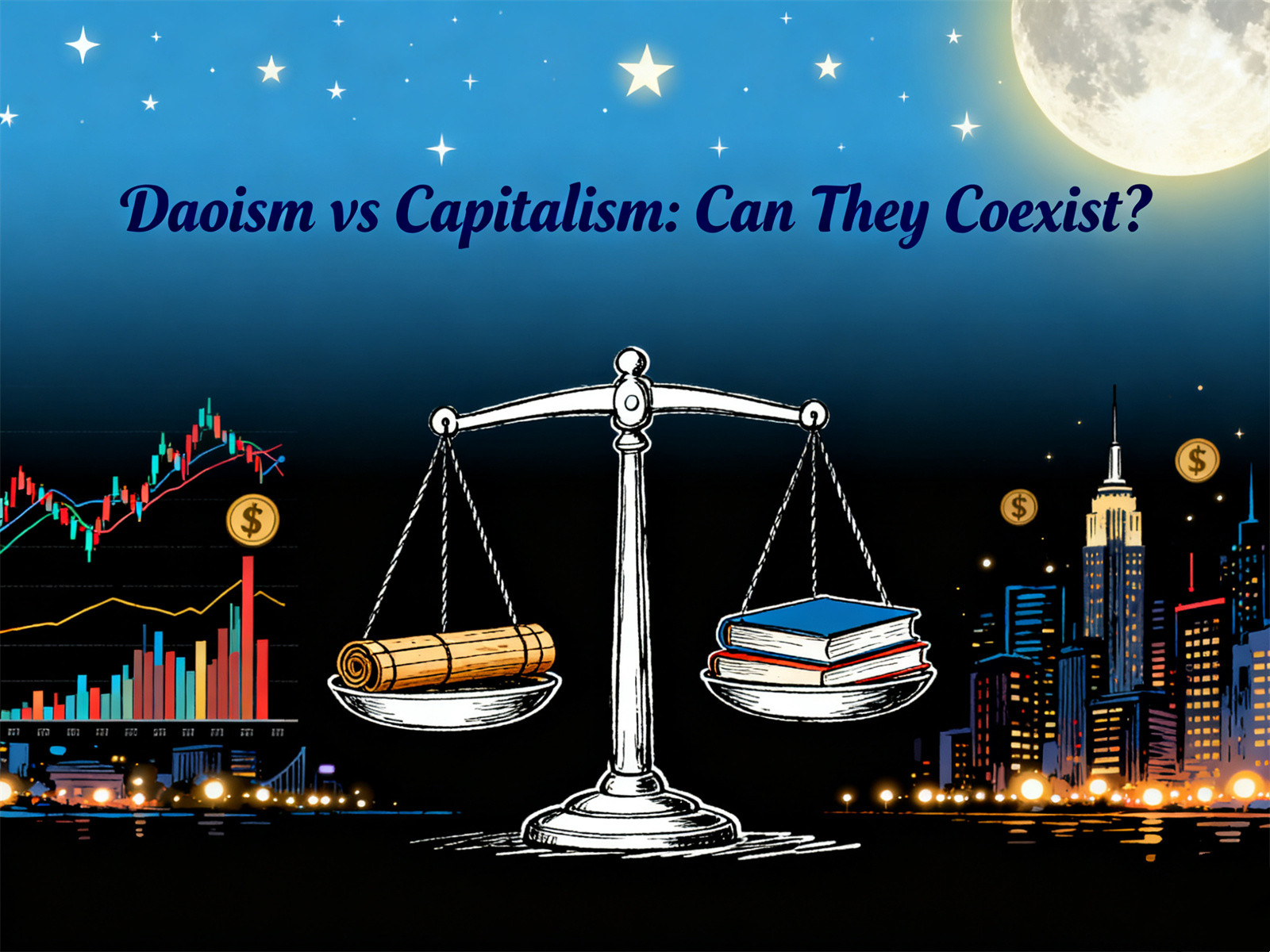
Daoism vs Capitalism: Can They Coexist?
Nov
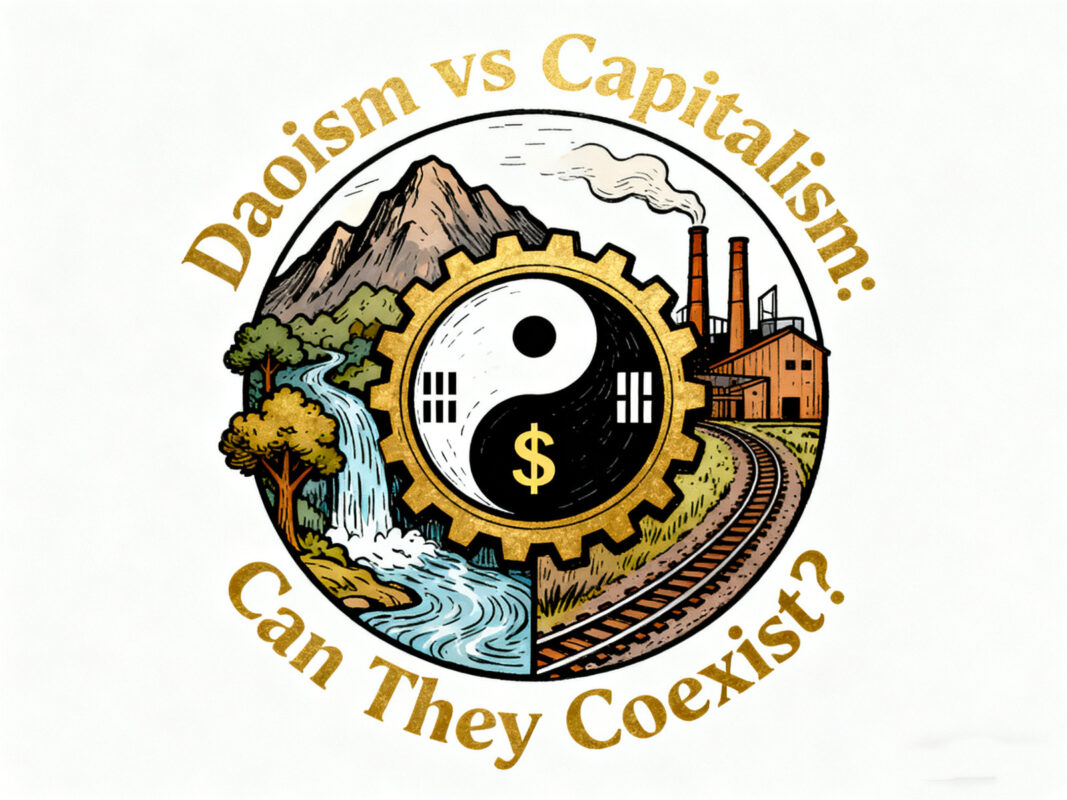
As the world rushes forward under the engines of global capitalism, the ancient philosophy of Daoism — with its quiet insistence on balance, humility, and harmony with nature — stands as both a mirror and a challenge to modern economic systems. The tension between these two worldviews invites a deeper question that transcends culture and ideology: can a philosophy rooted in non-attachment and natural flow truly coexist with a structure defined by profit, productivity, and perpetual expansion?
Across centuries, Daoism has shaped Chinese art, governance, medicine, and spiritual life, always emphasizing alignment with the natural order — the Dao, or “the Way.” Capitalism, by contrast, thrives on motion, innovation, and competitive growth. Yet, beneath their apparent opposition lies a subtle potential for reconciliation, if only one listens carefully to what each truly values.
This exploration of Daoism vs. Capitalism seeks not to condemn one or idealize the other, but to uncover how their interaction might evolve into a sustainable synthesis — a vision of prosperity that does not erode the world’s spiritual and ecological balance.
1. The Philosophical Foundations: The Dao and the Market
Daoism begins from an entirely different premise than modern economics. It does not define life in terms of accumulation or transaction, but in terms of flow and alignment. The Dao is not a deity or a doctrine; it is the underlying harmony of the universe, the principle through which all things rise and fall, come and go, without forced interference.
Capitalism, meanwhile, is driven by a principle of ceaseless motion — markets expand, resources circulate, innovation disrupts. From an economic perspective, stillness equals stagnation. Yet from a Daoist perspective, unending movement without pause leads to imbalance, exhaustion, and the eventual collapse of systems that ignore natural limits.
The Daoist View of Wealth and Simplicity
Daoist classics such as the Dao De Jing and Zhuangzi speak often of wealth and power — not to glorify them, but to caution against their seductions. “He who knows he has enough is rich,” writes Laozi, reminding readers that abundance lies not in possession but in contentment. The sage, unlike the merchant, measures prosperity by tranquility and inner alignment rather than external success.
This is not an argument against trade or creation; rather, it is a philosophy of sufficiency — a recognition that when the mind stops grasping, it discovers that everything it needs is already present.
2. The Capitalist Impulse: Creation or Consumption?
Capitalism, especially in its contemporary global form, has proven remarkably adept at generating wealth, improving living standards, and expanding access to goods and services. Its creative power mirrors, in a certain way, the Daoist ideal of transformation — the constant arising and dissolving of forms.
However, the engine of capitalism often runs on desire — the cultivation of perpetual need. Advertising, markets, and social trends turn the human psyche outward, attaching worth to novelty rather than essence. From a Daoist standpoint, this creates a cycle of “endless becoming” without true fulfillment — a kind of spiritual overheating in which individuals lose contact with their own natural rhythm.
The Paradox of Productivity
Daoist texts frequently praise wu wei — “non-forced action,” or the art of doing without overdoing. In this context, work becomes effortless because it flows from alignment rather than compulsion. Capitalism’s glorification of productivity, by contrast, often prizes output over harmony, treating rest and contemplation as inefficiencies rather than necessities.
In Daoist terms, this imbalance represents a loss of Yin — the receptive, restorative force that balances Yang’s assertive drive. A society that forgets stillness eventually burns out, just as a field over-cultivated without rotation becomes barren.
Thus, the central Daoist critique of capitalism is not moral but ecological: it violates the principle of rhythm that sustains both nature and human vitality.
3. Points of Tension and the Possibility of Integration
Despite their differences, Daoism and capitalism are not irreconcilable. In fact, their meeting point may represent one of the most critical philosophical frontiers of our time — the search for a sustainable economy of consciousness.
The Question of Value
Capitalism assigns value through exchange: something is worth what others are willing to pay for it. Daoism measures value in accordance with the Dao — usefulness, harmony, and balance. A mountain, in Daoist thought, has value not because it can be mined but because it simply is.
The conflict arises when the capitalist lens commodifies what Daoism deems sacred — water, land, even time. Yet, if reinterpreted through a Daoist ethic, capitalism could evolve toward a form of “conscious commerce,” where economic activity honors natural balance rather than consuming it. Emerging movements in sustainable business, slow living, and ecological design already echo this shift, suggesting that markets, too, can learn to breathe.
The Role of the Individual
For the individual, coexistence depends on internal awareness. A person guided by Daoist insight can participate in capitalist systems without being enslaved by them. One can work, trade, and even lead, while maintaining detachment — a freedom rooted not in withdrawal but in understanding.
In this sense, Daoism offers capitalism a moral compass: reminding the entrepreneur or the innovator that success without balance is ultimately self-defeating.
4. Modern Expressions of Daoist Values in the Capitalist World
Daoism’s resurgence in global consciousness — through wellness practices, ecological design, and philosophical study — shows that even within capitalist structures, ancient wisdom can flourish. The modern reinterpretation of Daoist thought does not demand the rejection of wealth or technology; rather, it invites the reorientation of purpose.
Eco-Economics and Natural Flow
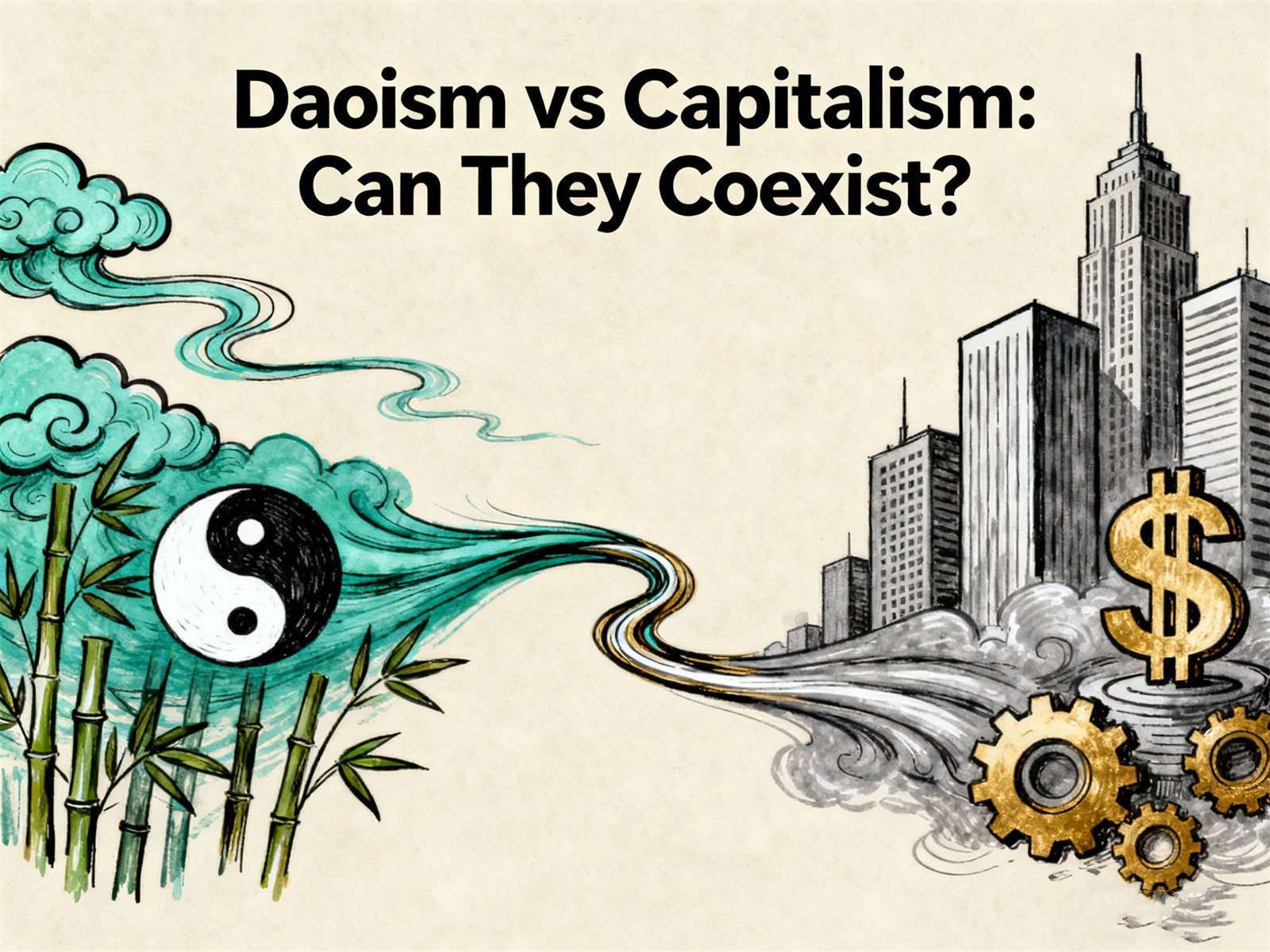
In the face of climate change and resource depletion, capitalism finds itself confronting the same natural laws that Daoism reveres. Concepts such as the circular economy — where waste becomes resource and systems sustain themselves — echo Daoist notions of cyclical transformation. Here, profit aligns with renewal, and economic systems mirror the ecological balance of Yin and Yang.
Architects, urban planners, and environmental scientists increasingly invoke Daoist principles of flow, flexibility, and minimal interference in sustainable design. In this quiet way, the Dao re-enters the modern world — not through doctrine, but through practice.
Mindful Consumption and the Return to Simplicity
The growing popularity of minimalism, slow fashion, and ethical production represents a cultural yearning for balance. These trends, though born in capitalist societies, embody Daoist sensibilities: moderation, awareness, and respect for the inherent life of things.
Even aesthetic movements inspired by Dao decor or Dao jewelry reflect this fusion — material beauty infused with spiritual symbolism, possessions that remind rather than distract, adornments that restore meaning to ownership. In this way, consumption becomes a meditation rather than an escape.
5. The Future: Toward a Dao of Economics
The reconciliation of Daoism and capitalism may not lie in policy or ideology but in a shift of consciousness. It calls for an economy guided not by endless growth but by the living equilibrium that the Daoists observed in the natural world — the dance of water and stone, giving and receiving, expansion and contraction.
Harmony as Efficiency
In business terms, harmony is often mistaken for passivity, but Daoism teaches that true efficiency arises from alignment. Just as a river carves valleys with gentle persistence, sustainable progress arises from cooperation with natural laws, not domination of them. Corporations that adopt regenerative models — renewable energy, fair trade, or circular manufacturing — already demonstrate how harmony enhances resilience.
The Inner Economy
On a personal level, Daoism offers a model of internal capitalism — not of accumulating wealth, but of cultivating Qi, the vital energy that fuels creativity and well-being. In this metaphorical economy, the heart is both investor and market, and the profit is measured in clarity, kindness, and vitality.
If such a shift takes root, capitalism could evolve from a system of extraction to one of participation — where economic life reflects not human conquest over nature but humanity’s rediscovery of its place within it.
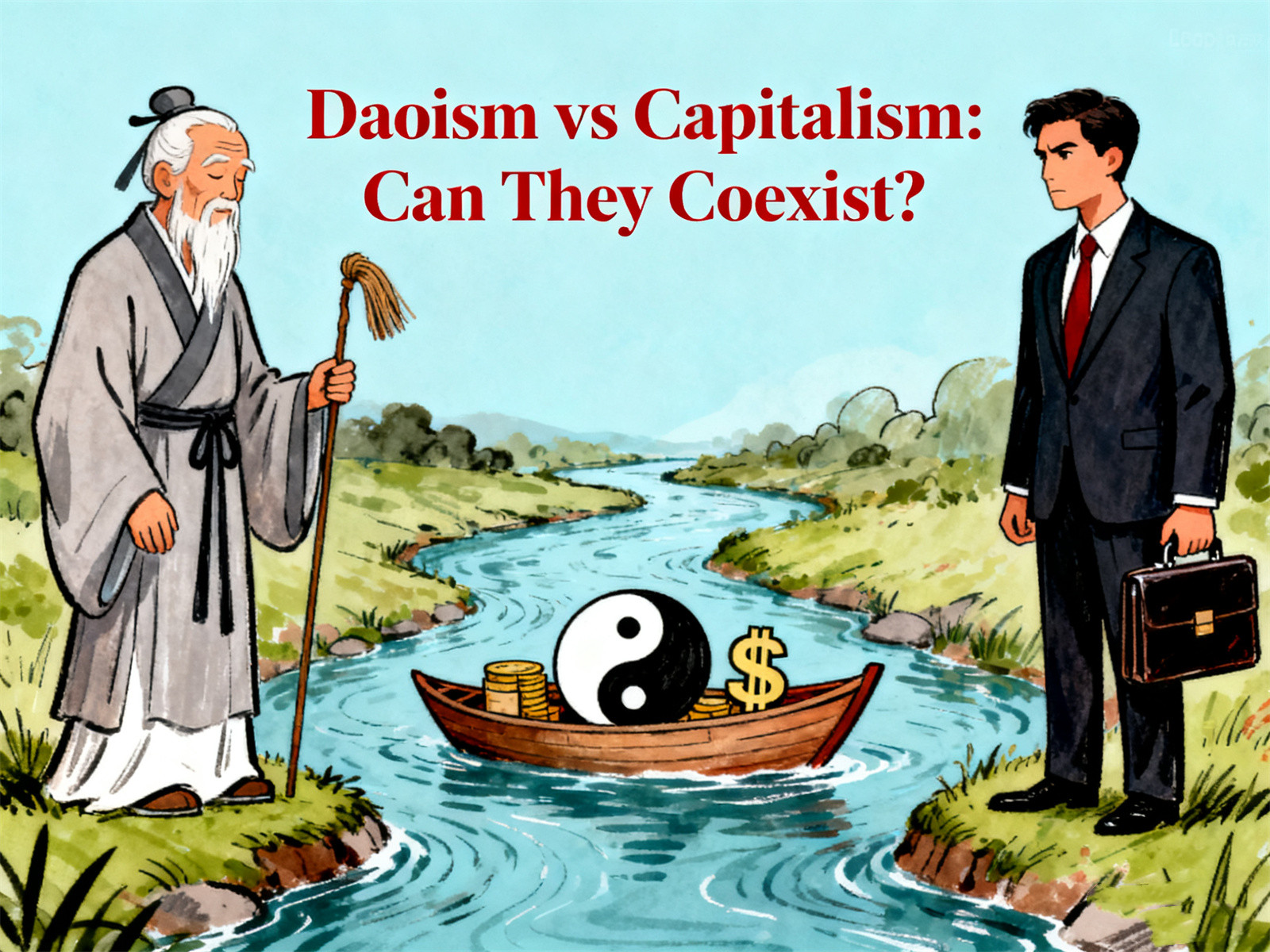
The Bridge Between Worlds
In this imagined coexistence, the entrepreneur learns stillness, and the sage embraces creation. Profit becomes not the enemy of the Dao but its servant, channeling abundance through balance. Such harmony will not come from regulation alone but from a transformation of intention — the rediscovery that to follow the Way is also to sustain the world.
As the Dao De Jing reminds us: “He who follows the earth, the earth follows heaven, heaven follows the Dao, and the Dao follows what is natural.” In the same manner, economies that follow the rhythms of nature will endure beyond those that defy them.
Perhaps, in this new synthesis, the quiet wisdom of the Dao and the dynamic drive of capitalism will cease to compete and begin to dance — two halves of the same eternal circle, each completing what the other lacks.
And in that dance, the modern world may finally glimpse what ancient sages already knew: that true wealth lies not in ownership, but in harmony; not in possession, but in presence.