
Interesting Dao
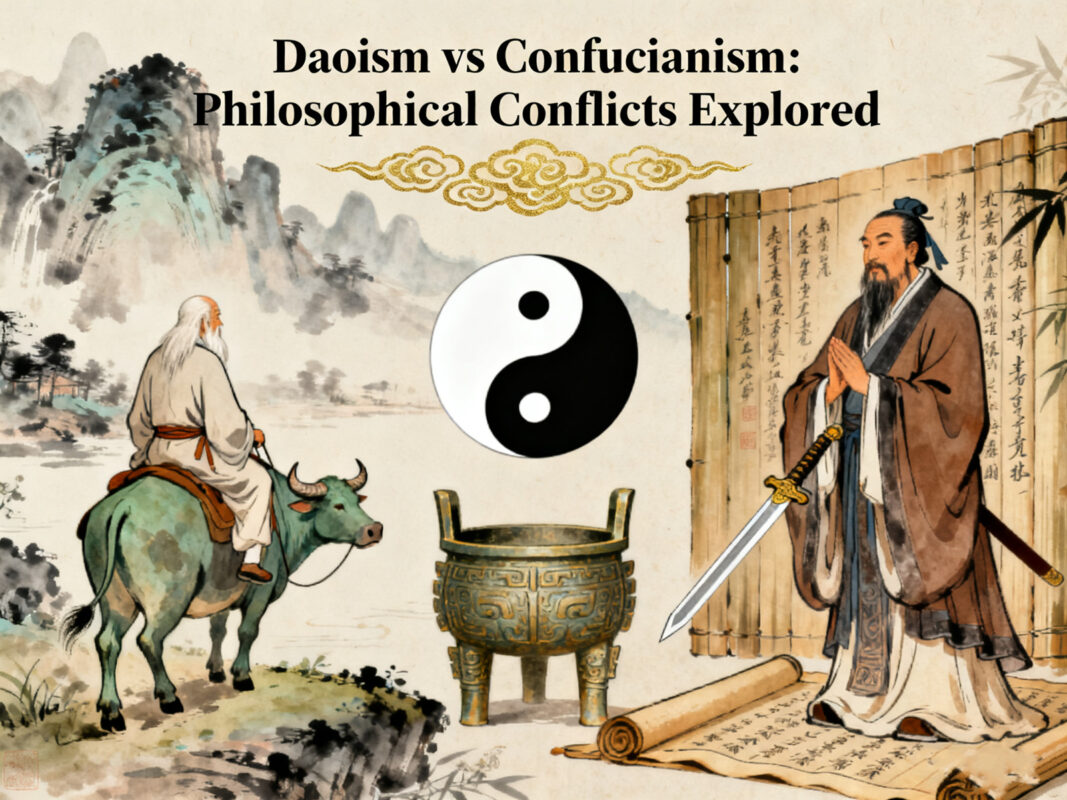
Daoism vs Confucianism: Philosophical Conflicts Explored
Nov
For more than two thousand years, the twin traditions of Daoism and Confucianism have shaped the moral, intellectual, and spiritual life of China. They emerged from the same cultural soil but grew in radically different directions. One gazed outward at social order and ethical obligation, seeking to shape civilization through discipline and ritual. The other looked inward toward the ungraspable Way of nature, favoring spontaneity, humility, and alignment with the cosmic flow. Together they represent a profound philosophical dialogue about the human condition — a dialogue not of enemies, but of contrasts so deep that they illuminate one another.
Today, as modern people search for meaning amid technological acceleration and social fragmentation, the tension between Daoist naturalism and Confucian moralism still resonates. Understanding their conflicts and the subtle harmony that sometimes bridges them opens a pathway toward a richer, more balanced view of life.
1. The Historical Foundations: Two Responses to a Time of Chaos
Both Daoism and Confucianism arose during the Warring States period (475–221 BCE), an era when China was divided into competing kingdoms, each striving for power through strategy, bureaucracy, and war. The old social order had collapsed, traditional rites had lost their authority, and thinkers sought answers to the question: How should human beings live in a disordered world?
Confucius and the Revival of Order
Confucius (Kongzi, 551–479 BCE) responded to chaos by turning back to the ideals of an earlier age. He envisioned a society ruled not by force but by virtue (de), harmony, and the moral example of cultivated leaders. His philosophy centered on ren (humaneness), li (ritual propriety), and yi (righteousness), all of which were designed to restore trust and order in human relationships. To Confucius, civilization was a moral project; every individual had a role to play in perfecting the social fabric through self-cultivation and ethical duty.
The Analects — a collection of his sayings and dialogues — reveal a man deeply concerned with the art of living together. For him, a stable state and a harmonious family mirrored the moral alignment of the individual. Thus, virtue began in the self but radiated outward, shaping society through example and education.
Laozi and the Turn to Nature
Laozi, often regarded as the founder of Daoism, offered a strikingly different response. Where Confucius sought order through human effort, Laozi taught that excessive striving only deepened disorder. His Dao De Jing begins with a paradox: “The Dao that can be spoken is not the eternal Dao.” This line encapsulates the Daoist insight that truth is not constructed through moral systems or intellectual debate, but realized through alignment with the Dao — the ineffable Way that gives rise to all things.
For Laozi, the key was not to perfect society but to return to simplicity, to rediscover the natural flow of existence uncorrupted by ambition and artificial codes. While Confucianism demanded discipline and duty, Daoism counseled wu wei — “non-forcing,” or effortless action in harmony with the natural course of events.
Thus, from their very beginnings, the two philosophies represented opposite instincts: the Confucian desire to build order through cultivation, and the Daoist desire to dissolve tension through letting go.
2. Human Nature and the Question of the Self
At the core of the philosophical divide lies a question as old as civilization itself: What is human nature?
Confucian Moral Optimism
Confucianism, particularly as later developed by Mencius (Mengzi, 372–289 BCE), maintained that human beings are fundamentally good. Mencius argued that people possess the four beginnings — innate sprouts of compassion, shame, courtesy, and moral discernment — which, if properly nurtured, grow into the virtues of humanity, righteousness, propriety, and wisdom. This optimistic view justified the Confucian emphasis on education and ritual, since these practices cultivate the moral seeds already planted in the heart.
In this view, self-improvement is both possible and necessary. The ideal person, or junzi (noble one), constantly refines themselves through reflection and moral discipline. The self is seen as a work in progress, sculpted by learning and guided by the models of sages and ancestors.
Daoist Naturalism and the Uncarved Block
Daoism, by contrast, regards human nature not as something to be perfected, but as something to be preserved. Laozi speaks of the “uncarved block” (pu) — a metaphor for the original, unconditioned state of being before social expectations and artificial desires distort it. In the Daoist view, the more one tries to “improve” human nature through rules and rituals, the further one drifts from authenticity.
For Zhuangzi, the great Daoist sage who followed Laozi, the self is fluid, boundless, and inseparable from the natural world. He mocked the Confucian obsession with moral correctness, suggesting that wisdom lies not in shaping oneself to fit a standard but in flowing with the transformations of life. When one forgets the self, one becomes fully alive — a part of the infinite rhythm of the Dao.
This difference in orientation is crucial: Confucianism defines the self in relation to society, while Daoism dissolves the self into the cosmos. One seeks harmony through structure; the other through surrender.
3. The Moral Order vs. the Natural Order
The tension between Daoism and Confucianism can also be seen as a conflict between two kinds of order: the moral and the natural.
The Confucian Social Vision
Confucianism envisions a universe structured by hierarchical harmony. Just as heaven, earth, and humanity form an ordered triad, so too must society follow patterns of proper relationship — ruler and subject, parent and child, husband and wife, elder and younger. Harmony arises when each fulfills their role with sincerity and respect.
In this system, ritual (li) serves as both expression and instrument of moral order. Rituals embody values, cultivate emotional refinement, and bind communities together. Through the repetition of ritual acts — bowing, mourning, offering, speaking courteously — individuals internalize the moral rhythm of civilization. For Confucius, without ritual, the human heart drifts toward chaos.
The Daoist Rejection of Artificial Hierarchy
Daoism views such systems with suspicion. To Laozi, the proliferation of laws and rituals is a symptom of decline, not progress. In one verse he laments, “When the great Dao is abandoned, there appears benevolence and righteousness.” This is not a celebration of lawlessness but a critique of overcivilization — the idea that moral codes replace natural goodness when authenticity is lost.
For Daoists, genuine order does not arise from rule but from resonance. The cosmos is already balanced; it does not need to be managed. The sage rules by not ruling, creating conditions in which harmony arises naturally. In politics, this translates into minimal interference — government as gardener, not engineer.
The contrast is sharp: Confucianism builds order through conscious structure, while Daoism uncovers order through organic spontaneity. Yet both share a longing for harmony, differing only in their method of approach.
4. Knowledge, Action, and the Art of Living
Confucian Learning and Moral Responsibility
For Confucians, knowledge and action are inseparable. Learning is not about accumulating information but about transforming character. The Great Learning, one of the Confucian classics, outlines a sequence: investigate things, extend knowledge, make intentions sincere, rectify the mind, cultivate the person, regulate the family, and finally govern the state. Each step connects inner virtue with outer action.
Confucian wisdom is therefore practical — it insists that morality manifests in behavior. To be educated is to embody propriety, compassion, and justice in everyday conduct.
Daoist Wisdom and Effortless Mastery
Daoism, on the other hand, teaches that excessive striving for knowledge blinds us to truth. “Those who know do not speak; those who speak do not know,” Laozi warns. The Dao cannot be grasped intellectually; it must be lived intuitively. The true sage acts without conscious effort, moving in sync with the Way.
In Daoist stories, such as the famous tale of Cook Ding in Zhuangzi, skill becomes a form of meditation. The cook carves an ox effortlessly because he follows the natural joints of the animal; his blade never dulls. This is wu wei in action — mastery achieved through harmony with circumstance, not through force or analysis.
Applied to modern life, this principle suggests that creativity and leadership flourish when grounded in calm awareness rather than restless ambition. Interestingly, this spirit finds expression today in creative communities such as DaoCrafts.com, where artisans and thinkers explore how Daoist ideas can inform craftsmanship, mindfulness, and modern design — blending philosophy with living art.
5. The Dialogue Continues: Integration and Relevance Today
Despite their historical conflicts, Daoism and Confucianism have coexisted and intertwined for centuries, shaping Chinese culture not as opposing poles but as complementary forces. In imperial China, officials might study Confucian classics by day and retreat to Daoist meditation at night. The scholar who governed by moral discipline often sought personal renewal through Daoist simplicity.
Harmony Through Balance
The enduring wisdom lies in recognizing that both traditions address different dimensions of human existence. Confucianism governs the social and ethical realm — how we relate, serve, and lead. Daoism governs the existential and spiritual — how we breathe, flow, and let go. The true art of living may lie in weaving these together: acting responsibly while remaining inwardly free, engaging the world without being trapped by it.
This synthesis echoes in Chinese art, medicine, and aesthetics: the Confucian sense of order complements the Daoist sense of fluidity. Even in modern leadership and education, this balance remains relevant — discipline supported by intuition, reason tempered by empathy, ambition softened by humility.
Modern Implications
In a world increasingly shaped by competition, control, and technological intensity, Daoism reminds us to pause and listen, to act without overacting, to restore equilibrium between progress and presence. Confucianism reminds us that freedom without virtue collapses into chaos, and that moral cultivation remains essential for a sustainable community. Together, they form a conversation that transcends time.
Both traditions point toward harmony, but through different doors: one through the refinement of the self within society, the other through the dissolution of the self into nature. Understanding this dynamic tension does not demand that we choose one over the other; it calls us to integrate the wisdom of both — to act purposefully yet lightly, to care deeply yet without attachment, and to find in the middle path the true measure of human balance.
The dialogue between Daoism and Confucianism continues not as an academic exercise but as a living conversation about how to exist wisely — a reminder that harmony is not achieved by erasing difference, but by allowing opposites to complete each other. Laozi and Confucius, if they could speak to us today, might agree on this much: that the world’s greatest task remains the same — to live in rhythm with both the heart of humanity and the pulse of the cosmos.