Interesting Dao
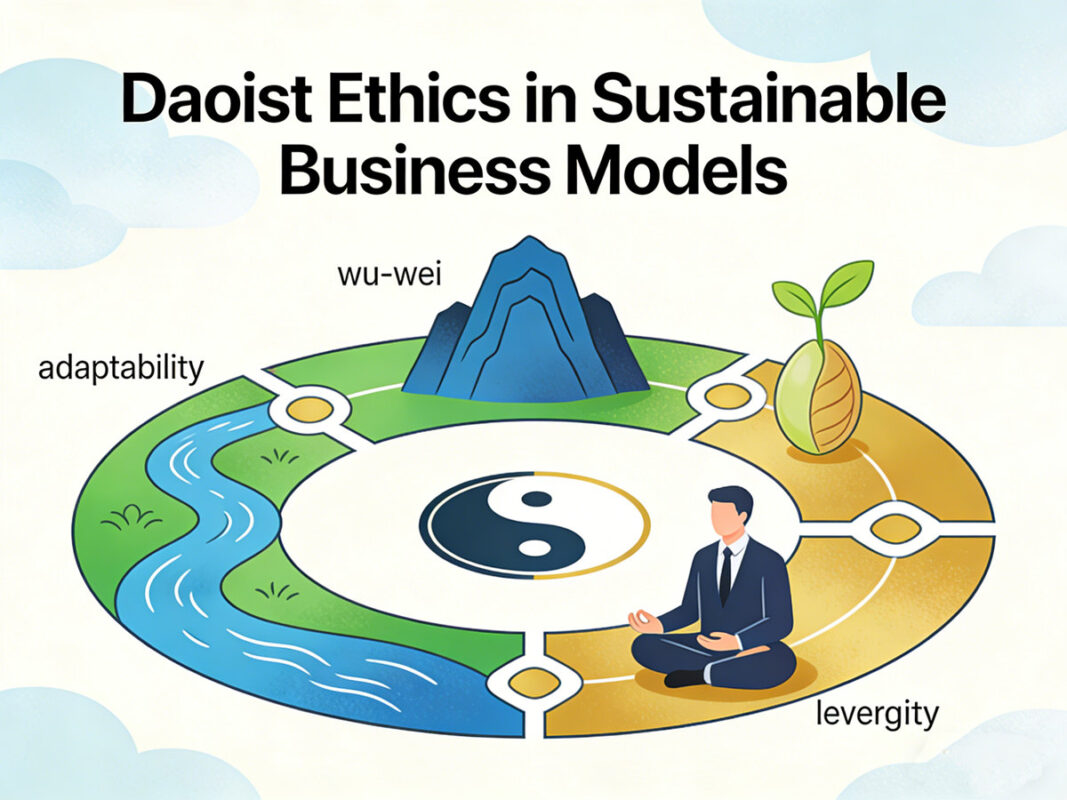
Daoist Ethics in Sustainable Business Models
Jan
In an era defined by climate crisis, resource depletion, and profound social inequity, the relentless pursuit of conventional growth-centric business models reveals its inherent fragility. The search for genuine sustainability – environmental stewardship, social equity, and long-term economic viability – demands not just technological fixes or regulatory compliance, but a fundamental philosophical shift. Unexpectedly, ancient Daoist wisdom, emerging from the mist-shrouded peaks of China millennia ago, offers a profoundly resonant and practical ethical framework for reimagining commerce. Rooted in principles of harmony, naturalness, and effortless action, Daoist ethics provide a compass for navigating the complex interplay between human enterprise and the living systems upon which all life depends. This exploration delves into how integrating core Daoist concepts – Wu Wei, Ziran, Yin-Yang balance, and the cultivation of Qi (vital energy) – can transform business models from extractive machines into regenerative, resilient, and deeply sustainable organisms flowing with, rather than against, the currents of the natural world.
I. Beyond Exploitation: Daoism’s Foundational Challenge to Conventional Commerce
Daoism, articulated in texts like the Daodejing and Zhuangzi, begins with a radical critique of human hubris and the artificial constructs that separate us from the Dao, the immanent, ineffable source and flow of all existence. This critique directly challenges the assumptions underpinning unsustainable business:
- The Illusion of Separation: Conventional models often treat nature as an infinite resource sink and waste repository, and communities as mere labor pools or markets. Daoism dissolves this illusion, emphasizing the fundamental interconnectedness of all phenomena – the Ten Thousand Things. A business operating under Daoist ethics inherently recognizes it is not an isolated entity, but a node within vast, interdependent ecological and social networks. Exploitation of nature or people becomes self-defeating, akin to a cell poisoning its own body.
- Rejecting Excessive Desire (Wu Yu): The Daodejing warns relentlessly against excessive desire (Wu Yu) and the pursuit of limitless accumulation. “He who knows he has enough is rich,” it states. This directly counters the growth-at-all-costs imperative driving ecological overshoot and social inequality. Daoist sustainability prioritizes sufficiency, moderation, and the intrinsic value of well-being over the relentless expansion of material throughput and profit maximization divorced from true flourishing.
- The Tyranny of the Artificial: Daoism venerates Ziran (自然) – “self-so,” or natural spontaneity. It mistrusts rigid, overly complex systems and artificial interventions that disrupt natural harmony. Many modern business processes, supply chains, and financial instruments represent precisely this kind of disruptive complexity. Daoist ethics encourage aligning business structures and processes with natural patterns and limits, seeking simplicity and elegance over artificial control.
II. Wu Wei: The Art of Effortless Action in Operations and Strategy
The concept of Wu Wei (无为), often mistranslated as “inaction,” is central to Daoist practice. It signifies action that is perfectly aligned with the Dao – effortless, spontaneous, and supremely effective because it works with the grain of reality, not against it. Applied to business, Wu Wei offers a transformative operational and strategic paradigm:
- Strategic Fluidity Over Rigid Plans: Instead of imposing rigid, top-down five-year plans that often become obsolete or force unnatural adaptations, Wu Wei encourages responsive, emergent strategy. This means deep, continuous sensing of the market, ecological context, and community needs. It involves adapting fluidly to changing conditions, like water flowing around obstacles, rather than expending vast energy to force a predetermined outcome. Businesses cultivate the ability to pivot gracefully, leveraging opportunities as they arise naturally within the flow of events.
- Process Optimization as Natural Flow: Operationally, Wu Wei manifests in streamlining processes to eliminate friction and waste (muda, in Lean terms), not through harsh control, but by understanding and aligning with the inherent logic of the work and materials. It involves designing systems where value flows effortlessly, minimizing unnecessary effort, complexity, and resource consumption. This could mean optimizing logistics to mimic efficient natural systems, creating self-organizing teams, or automating repetitive tasks to free human creativity.
- Empowered Emergence: Wu Wei leadership trusts in the emergent intelligence of the system. Instead of micromanaging, leaders cultivate conditions where employees, guided by clear principles rooted in sustainability and ethics, can respond spontaneously and effectively to challenges and opportunities. This fosters a culture of ownership, adaptability, and innovation aligned with the Dao of the business and its environment.
III. Ziran: Cultivating Naturalness in Product Design and Value Creation
Ziran emphasizes authenticity, spontaneity, and alignment with inherent nature. For business, this translates into how value is conceived, created, and delivered:
- Biomimicry and Circularity as Ziran Design: Products designed according to Ziran principles mimic nature’s efficiency and closed-loop systems. This is the essence of biomimicry and the circular economy. Materials are chosen for their inherent properties and renewability, designed for longevity, repairability, and ultimately, safe biodegradation or seamless upcycling. Waste is designed out, as in nature, where outputs become inputs. Think modular electronics, compostable packaging derived from mycelium, or buildings that regulate temperature like termite mounds.
- Authenticity and Intrinsic Value: Ziran challenges superficiality and planned obsolescence. Products and services should possess genuine, lasting value that meets authentic human needs in harmony with ecological limits. Marketing shifts from creating artificial desire to transparently communicating the true, inherent benefits and the sustainable story of the product’s journey. Value is derived from quality, durability, beauty, and positive impact, not just novelty or status.
- Honoring the Nature of Materials and Labor: Daoist ethics demand respect for the intrinsic nature (De) of everything. This means sourcing materials responsibly, understanding their origins and impacts, and treating them with care throughout their lifecycle. Crucially, it means honoring the De of employees and partners – fostering safe, dignified, meaningful work that allows individuals to express their own Ziran within the collaborative endeavor.
IV. Balancing Yin and Yang: Integrating Stakeholder Harmony
The dynamic interplay of Yin (receptive, yielding, nurturing) and Yang (active, assertive, creating) is fundamental to Daoist cosmology. Sustainable business requires a conscious balancing of these forces across all stakeholder relationships:
- Profit (Yang) & Purpose (Yin): Financial viability (Yang) is necessary, but it must be balanced by a deeper purpose (Yin) – contributing positively to society and the planet. This is not philanthropy bolted on, but purpose woven into the core business model. Profit becomes a measure of the health of the system, not its sole purpose.
- Competition (Yang) & Collaboration (Yin): Healthy competition (Yang) can drive innovation, but Daoist ethics emphasize the Yin power of collaboration, symbiosis, and mutual support. This means fostering cooperative networks within industries (e.g., pre-competitive sustainability initiatives), partnering with NGOs and communities, and viewing suppliers as long-term partners in creating shared value, not adversaries to be squeezed.
- Shareholder Returns (Yang) & Stakeholder Well-being (Yin): Moving beyond shareholder primacy requires actively balancing the demands of investors (Yang) with the needs and well-being of employees, customers, communities, and the environment (Yin). This involves fair wages, community investment, transparent communication, and embedding ecological costs into decision-making. True sustainability recognizes that long-term shareholder value is inextricably linked to thriving stakeholders.
V. Cultivating Qi: Vitality in Supply Chains and Organizational Energy
Qi represents the vital energy or life force that animates all things. A sustainable business model must nurture and harmonize Qi flow throughout its entire system:
- Regenerative Supply Chains: Linear, extractive supply chains deplete Qi – draining resources, degrading ecosystems, and exploiting labor. Daoist ethics inspire regenerative supply chains that actively restore and enhance Qi. This involves sourcing from regenerative agriculture that rebuilds soil health, partnering with suppliers using renewable energy and closed-loop water systems, and ensuring fair labor practices that energize, rather than deplete, the workforce. The focus shifts from minimizing harm to actively creating positive ecological and social vitality.
- Organizational Energy Flow: Internally, Qi manifests as employee morale, creativity, and resilience. A business that cultivates Qi fosters a healthy work environment: psychological safety, opportunities for growth and mastery, work-life rhythm (not just balance), and practices that reduce chronic stress (a major Qi blocker). Spaces designed with natural light, plants, and areas for quiet reflection (Dao decor principles) can enhance environmental Qi. Leaders act as Qi stewards, sensing blockages and facilitating the smooth flow of energy and information.
- Long-Term Resilience: Nurturing Qi builds resilience. A company with strong, positive Qi flow through its people, processes, and partnerships is better equipped to withstand shocks, adapt to change, and innovate sustainably. It avoids the burnout and fragility inherent in systems run on depleted resources and exhausted people.
VI. Governing with De: Virtuous Leadership for Sustainable Enterprise
De (德) is the virtuous power or integrity that arises from alignment with the Dao. Daoist leadership is not about dominance, but about embodying De and fostering it within the organization:
- Leading by Example (Wu Wei Leadership): Daoist leaders embody the principles they espouse – humility, simplicity, moderation, and deep respect for nature and people. They practice Wu Wei, guiding rather than commanding, creating the conditions for others to flourish. Their power stems from trust and authentic integrity, not hierarchy or coercion.
- Fostering Collective Wisdom: Recognizing that wisdom is distributed, leaders cultivate spaces for dialogue, reflection, and emergent solutions. They value diverse perspectives (balancing Yin and Yang voices) and practice deep listening. Decision-making incorporates sustainability and ethics as core criteria, often privileging long-term health over short-term gains.
- Stewardship Mentality: Leaders view themselves not as owners, but as stewards (Guanli) of the business, its people, and the resources it utilizes. Their mandate is to nurture and pass on a healthier, more vital enterprise and world to future generations. This inherently long-term view is fundamental to genuine sustainability.
VII. Navigating the Rapids: Challenges and Paradoxes
Integrating Daoist ethics into modern business is not without profound challenges and inherent paradoxes:
- The Profit Paradox: Can a business truly embody Wu Wei and Ziran while competing in a global market still dominated by extractive, growth-obsessed paradigms? This requires immense courage to redefine success metrics, resist short-term pressures, and potentially sacrifice maximum profits for deeper values. B Corps and steward-owned models offer promising pathways.
- Scale and Authenticity: Can Ziran and genuine interconnectedness be maintained as a business scales? Scaling often introduces complexity and distance from origins. Solutions may lie in decentralized, networked structures, maintaining strong local connections, and ensuring scale doesn’t dilute core ethical commitments.
- Cultural Translation: Applying ancient Chinese philosophical concepts in diverse global contexts requires sensitive adaptation, not literal translation. The core principles of harmony, naturalness, and effortless action are universal, but their expression must resonate within specific cultural and operational settings. Avoiding superficial appropriation is crucial.
- Measuring the Immeasurable: How do we quantify the flow of Qi, stakeholder harmony, or true alignment with the Dao? While ESG metrics and impact assessments are evolving, Daoist ethics challenge us to develop more holistic, qualitative ways of measuring business health beyond financials and simplistic sustainability scores.
VIII. The Flourishing Future: Integration and Embodied Practice
The journey towards Daoist-inspired sustainable business is an ongoing process of integration, moving beyond theoretical frameworks into embodied practice that subtly reshapes the physical and cultural fabric of enterprise:
- From Theory to Tangible Culture: Embedding these ethics requires weaving them into corporate values, governance documents (like steward-ownership charters or B Corp commitments), performance metrics, incentive structures, and daily rituals. It becomes the lived culture, the “water” in which the business swims.
- Holistic Metrics and Reporting: Pioneering frameworks are emerging that attempt to capture holistic health – integrating financial, ecological, social, and cultural vitality metrics. Reporting moves beyond compliance to telling the story of the business’s relationship with the Dao of its environment and community.
- The Aesthetics of Sustainability: Dao Decor and Dao Crafts: The influence extends into the very spaces and artifacts of business. Dao decor principles inform workplace design – creating environments that foster Qi flow through harmonious layouts, natural materials (wood, stone, bamboo), abundant plants, water features, and areas of contemplative quiet (Liúbái – intentional emptiness). This reduces stress and enhances creativity and connection. Similarly, dao crafts find expression in the business realm. This could manifest in the meticulous, mindful design of products that honor materials and utility, the handcrafted elements within a service experience, or even the support for traditional artisans whose work embodies Wu Wei and Ziran. Choosing furnishings from local woodworkers using sustainable timber, incorporating hand-thrown pottery in office kitchens, or commissioning site-specific art that reflects the local ecosystem – these are not mere aesthetics. They are tangible manifestations of the ethics, grounding the abstract principles in the sensory world. They serve as constant, subtle reminders of the values the business holds: reverence for nature, the beauty of authenticity, the importance of mindful creation, and the interconnectedness of all effort. The presence of dao decor and dao crafts transforms the workplace from a sterile efficiency unit into a living ecosystem reflecting the harmony and natural flow the business seeks to embody in its core operations, making the Dao of sustainability visible, tactile, and integrated into the daily experience of work and value creation. This seamless blending of principle and practice signifies the maturation of a business truly flowing with the Dao.