
Interesting Dao
Daoist Principles in Space Habitat Design
Nov
In an age when human civilization stands on the brink of interplanetary expansion, discussions around the architecture of space habitats often focus on engineering, material science, and life support systems. Yet beneath the technical layers of pressure regulation and artificial gravity lies a deeper question—how should humans live in space, not merely survive there? What values, aesthetics, and philosophies should inform the design of future off-world environments? While most current design philosophies come from Western scientific rationalism, an unexpected yet profoundly relevant framework emerges from ancient China: Daoism.
Daoist principles—rooted in harmony, balance, and the natural flow of energy—offer more than poetic guidance; they provide a coherent and holistic philosophy of sustainability, adaptability, and mental well-being. In the context of designing habitats beyond Earth, Daoist insights can help create spaces that are not only functional but also psychologically nourishing, symbolically meaningful, and spiritually balanced.
1. The Daoist Worldview and Its Architectural Implications
To understand how Daoist thinking can inform space habitat design, one must first grasp how Daoism conceptualizes existence. The Dao (道), often translated as “the Way,” represents the underlying order of the universe—a dynamic, self-organizing process that sustains all phenomena. Human beings, in this view, are not separate from nature but part of its continuous unfolding.
Harmony between microcosm and macrocosm
This interconnection suggests that the human environment should reflect cosmic balance. Just as ancient Daoist temples were designed to align with mountains, rivers, and celestial patterns, space habitats can be conceived as extensions of this cosmic harmony—artificial ecosystems that emulate the self-regulating principles of natural ones.
Rather than imposing human control over matter, Daoism teaches alignment with flow (wu wei, 無為), an approach that emphasizes adaptive design rather than domination. In architectural terms, this could mean designing habitats that work with environmental systems—using passive energy regulation, natural cycles, and self-sustaining ecological feedback loops to maintain equilibrium rather than enforcing it mechanically.
This shift in perspective—from “command and control” to “listen and harmonize”—could become the foundation for a new philosophy of space architecture, one that integrates advanced technology with ancient wisdom.
2. Yin and Yang in Spatial Dynamics
The Yin-Yang principle is perhaps the most iconic Daoist concept, describing the interdependence of opposites and the cyclical nature of transformation. In space habitat design, this principle translates into a sophisticated balance between light and shadow, openness and enclosure, activity and rest, technology and contemplation.
Light and shadow equilibrium
In space, where sunlight is unfiltered and darkness absolute, the modulation of light becomes a matter not only of comfort but of psychological stability. Daoist design would seek to cultivate dynamic contrast, where illumination flows like breathing—bright spaces for activity alternating with shaded, meditative zones that calm the senses.
Balance between privacy and community
Likewise, the architecture should reflect the Yin-Yang tension between the individual and the collective. Each astronaut—or space inhabitant—needs solitude for restoration and focus (Yin), yet also requires shared environments for collaboration and connection (Yang). A Daoist-inspired habitat would choreograph this movement between retreat and engagement, crafting spatial rhythms that mirror the breathing of life itself.
In the Daoist worldview, balance is not achieved through symmetry but through fluid equilibrium—an ever-adjusting dance that maintains harmony amid change. Translating this into design requires not static geometry but responsive architecture: systems that adapt lighting, air flow, and configuration dynamically to maintain psycho-physical balance.
3. Wu Wei and the Principle of Effortless Design
The Daoist concept of wu wei—literally “non-action” or “effortless action”—does not mean doing nothing but rather acting in accordance with natural tendencies, avoiding excess and friction. In the context of architecture and engineering, this principle implies a shift from over-engineering to organic design, where every structure serves a natural purpose and nothing is wasted.
Design that follows nature’s intelligence
For example, instead of forcing rigid temperature control through continuous energy expenditure, a Daoist-informed space habitat might adopt biomimetic design, using layers of materials that naturally regulate heat, reflect radiation, or store energy in ways similar to biological tissues. The habitat would become a living organism rather than a mechanical container.
Similarly, waste management, oxygen generation, and food production could be integrated into closed-loop systems modeled after ecosystems—water recycled through plants, carbon transformed by algae, and waste composted into nutrient cycles. These are not just engineering tricks but direct expressions of Daoist thinking: life sustained through flow, not through control.
The elegance of simplicity
Daoism values simplicity (pu, 樸)—the “uncarved block.” A space designed with wu wei in mind would avoid over-decoration and prioritize clarity, calm, and purpose. Surfaces would be smooth but not sterile; forms would flow naturally, encouraging quiet mindfulness. This simplicity, far from austerity, creates psychological spaciousness—a mental landscape essential for long-duration missions in confined environments.
4. The Five Elements and Material Harmony
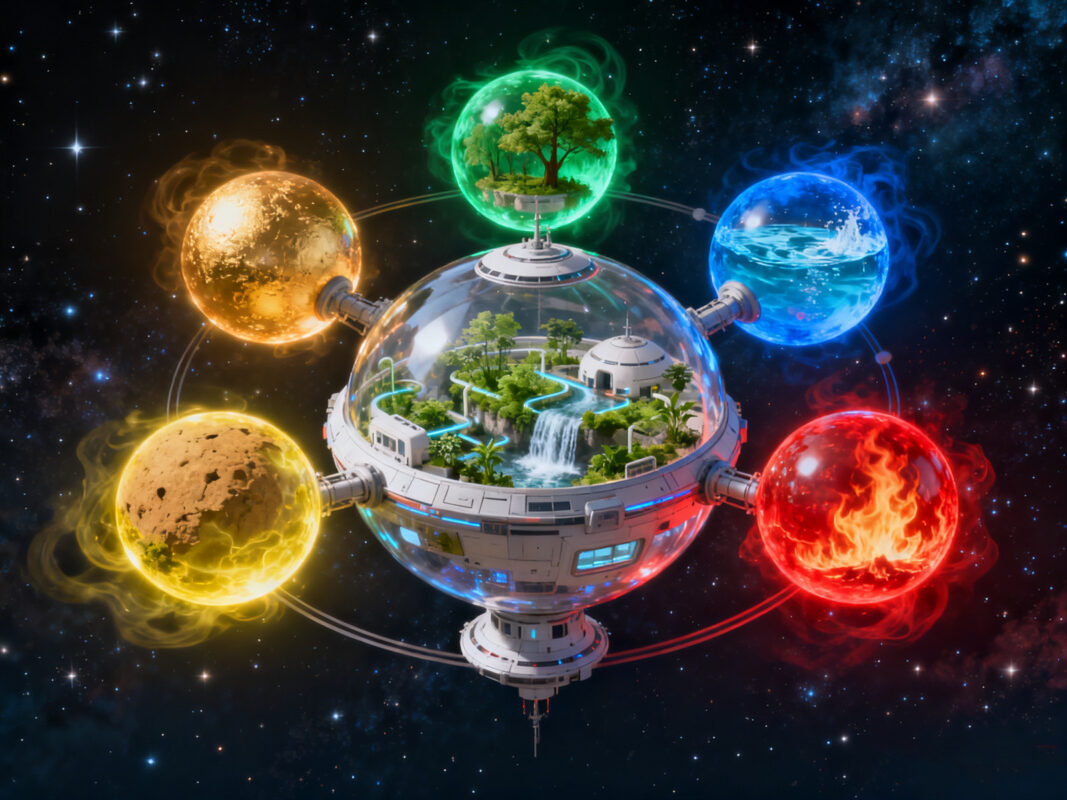
Daoist cosmology organizes all phenomena through the Five Elements (Wu Xing): Wood, Fire, Earth, Metal, and Water. These are not substances but phases of transformation, representing cycles of growth, decay, and renewal. Applying this model to space habitat design opens a multidimensional approach to material choice, energy flow, and environmental aesthetics.
Elemental correspondences in design
Each element carries symbolic and functional associations:
- Wood signifies vitality and growth—represented in structures that are flexible, renewable, and life-supportive, such as hydroponic plant modules or bio-based materials.
- Fire symbolizes energy and transformation—embodied in lighting, power systems, and the controlled management of thermal energy.
- Earth represents stability and nourishment—reflected in grounding materials, color palettes, and the psychological sense of security within the habitat.
- Metal stands for structure and resilience—its properties essential for the skeleton of the habitat, yet in Daoist design, metal should always remain in dialogue with softness and life.
- Water embodies adaptability and reflection—mirrored in air circulation, humidity control, and soundscapes that evoke fluid calm.
The goal is not simply to represent these elements aesthetically but to synchronize their interactions, so that the entire habitat becomes a balanced ecosystem. When these cycles are harmonized, the environment supports not only physical survival but also emotional equilibrium and spiritual well-being.
Emotional resonance of materials
Materials in Daoist-inspired architecture are chosen for their resonance, not merely their utility. In space, where every gram of mass is precious, this principle still applies—materials must not only perform but also evoke connection, grounding humans emotionally even when floating millions of kilometers from Earth. This could manifest in tactile surfaces that remind the inhabitant of soil, wood, or water—subtle sensory cues that restore a sense of belonging to the cosmic whole.
5. Feng Shui Beyond Earth
Feng Shui, often misunderstood as mere superstition, is in fact a highly sophisticated Daoist environmental science of spatial harmony and energetic flow. In the context of space habitats, Feng Shui offers valuable insights into orientation, movement, and psychological well-being.
The flow of Qi in artificial environments
In Daoist terms, Qi (氣) is the vital energy that animates all things. On Earth, Qi flows through landscapes, winds, and waterways. In space, this flow becomes a metaphor for environmental energy balance—air circulation, electromagnetic fields, light distribution, and even social interactions.
A Daoist-inspired habitat would manage these flows consciously: ensuring that air moves gently rather than harshly, that light nourishes without glaring, and that paths between spaces encourage natural transitions. The layout would avoid stagnation—both literal (in air or water systems) and metaphorical (in emotional or social energy).
Spatial orientation and the cosmic axis
Traditional Feng Shui aligns buildings with cardinal directions and celestial bodies. Though space habitats orbit or drift beyond Earth’s surface, this principle remains symbolically potent. Orienting living quarters toward specific stars or solar angles could create a psychological sense of cosmic belonging, mitigating the isolation of deep space. The habitat itself might be structured like a miniature cosmos, echoing the traditional Daoist temple: a central axis symbolizing Heaven and Earth connection, surrounded by circular movement representing the eternal flow of Dao.
In this sense, Daoist spatial philosophy transforms the space station from a sterile lab into a living mandala—a vessel not only for survival but for spiritual continuity.
6. Toward a Daoist Aesthetic of Cosmic Dwelling
To design for space through Daoist eyes is to recognize that human life, even in the most artificial environments, must remain rooted in the natural order. This is not nostalgia for nature but a profound affirmation of interdependence. The Dao does not disappear in the vacuum; it manifests wherever there is pattern, rhythm, and transformation.
Psychological resilience through harmony
Space travel presents intense psychological challenges: confinement, sensory monotony, and detachment from Earthly cycles. A Daoist-inspired design can mitigate these effects through aesthetic coherence, soft visual transitions, rhythmic lighting that mimics circadian flow, and quiet spaces for meditation or reflection. In the Daoist tradition, stillness (jing, 靜) is not the absence of movement but the inner calm that allows one to move effortlessly within chaos. Designing habitats that nurture this stillness may prove as vital as oxygen recycling systems.
The symbolic power of ritual and beauty
Daoist architecture on Earth integrates art, ornament, and symbolism not for display but for alignment. In space, symbols of harmony—curving forms, balanced symmetry, and natural motifs—can anchor the psyche, reminding inhabitants that they are part of a larger cosmic unfolding. Personal expressions such as Dao jewelry or Dao accessories, modestly worn within such environments, could serve not as fashion but as daily meditative reminders of connection with the Dao, the self, and the surrounding energy field.
The Dao of future dwelling
Ultimately, applying Daoist principles to space design is not a matter of aesthetics alone; it is a question of philosophical survival. The same mindset that led humanity to conquer nature must now evolve toward cooperation with it, especially when “nature” becomes the closed-loop systems we create to sustain life beyond Earth. The Daoist vision offers a model of reciprocal intelligence, where technology, biology, and consciousness form an integrated whole.
In this future, the space habitat is not a fortress against the void but a floating garden of balance, a manifestation of the Dao in motion—a place where human life harmonizes with the rhythms of the cosmos rather than resisting them. And perhaps, in the quiet hum of those distant habitats, the wisdom of the ancient sages will find new resonance, whispering across the stars that even in the farthest reaches of space, the Way is still present, guiding life toward equilibrium, humility, and wonder.