
Interesting Dao
Daoist Psychology for Stress Reduction
Jan
We inhabit an era defined by an unprecedented velocity of life, a relentless barrage of demands, notifications, and expectations that conspire to fracture our attention and erode our inner equilibrium. The resulting epidemic of chronic stress manifests not merely as transient discomfort but as a profound dysregulation of our entire being – mentally, emotionally, and physically. Conventional approaches often focus on symptom management or coping mechanisms layered onto the existing frenzy. Daoist psychology, however, originating from the profound wisdom of ancient Chinese sages like Laozi and Zhuangzi, offers a radically different paradigm. It invites us not merely to cope with stress, but to fundamentally realign our existence with the natural rhythms of the cosmos, the Dao, thereby dissolving the very roots of tension and cultivating an enduring state of effortless harmony known as Wu Wei. This perspective sees stress not as an inevitable byproduct of modern life, but as a signal of disconnection – a call to return to our intrinsic nature and the flow of Qi, the vital life force animating all things. It is a psychology of integration, teaching us to navigate turbulence with the adaptability of water and the rooted stillness of a mountain.
I. The Daoist Lens: Understanding Stress as Disconnection & Resistance
Daoist psychology provides a sophisticated diagnostic framework for understanding the origins of stress, viewing it primarily as a consequence of dissonance between human activity and the fundamental principles of the Dao.
- The Pathology of Forced Action (Wei): Stress arises when we operate primarily through Wei – forced, ego-driven striving. This manifests as rigid goal obsession, constant pushing against natural limits, micromanagement, and an inability to accept the unfolding of events. Every instance of forcing creates internal friction, exhausting our Jing (essence) and depleting Qi.
- Resisting the Natural Flow (Resisting Change): The Dao is characterized by constant, cyclical transformation (Yi). Stress intensifies when we cling to fixed outcomes, resist inevitable change (loss, transition, impermanence), or demand absolute control over life’s inherent unpredictability. This resistance creates psychological turbulence, akin to a river fighting its own current.
- Fragmentation & Loss of Center: Modern life encourages a scattered existence – multitasking, fractured attention, and over-identification with roles and external demands. Daoism views this as a loss of connection to our essential core, the True Self (Zhen Ren), obscured beneath layers of social conditioning and incessant mental chatter. This fragmentation generates anxiety and a pervasive sense of unease.
- Qi Stagnation & Shen Disturbance: From a physiological perspective, chronic stress directly impacts the flow of Qi. Blockages and stagnation in the body’s energy pathways (meridians) manifest as tension, pain, fatigue, and illness. Simultaneously, our Shen (spirit/mind), which should reside calmly in the heart center, becomes agitated and restless, leading to insomnia, anxiety, and impaired judgment. Stress is thus somatic and energetic, not merely psychological.
II. The Pillars of Daoist Stress Reduction: Aligning with the Dao
The remedy lies not in adding more techniques to an overwhelmed system, but in simplifying and realigning with core principles that foster innate resilience:
- Cultivating Wu Wei (Effortless Action): This is not passive resignation but action in accordance with the Dao. It involves developing profound sensitivity to the inherent intelligence of situations, responding spontaneously (Ziran) without ego-interference, and trusting the natural unfolding. It means discerning when to act and when to yield, reducing unnecessary struggle. Stress diminishes as actions become fluid, timely, and efficient.
- Embracing Yin & Yang Equilibrium: Daoism teaches the dynamic interplay of complementary opposites. Chronic stress often represents a dangerous Yang excess – hyperactivity, over-stimulation, relentless doing. Restoration requires consciously nurturing Yin qualities: receptivity, stillness (Jing), introspection, rest, and allowing. Practices that restore Yin-Yang balance are foundational to stress resilience.
- Nourishing Qi & Conserving Jing: Stress depletes our vital resources. Daoist psychology emphasizes practices that actively cultivate and circulate Qi (breathwork, gentle movement like Qigong/Tai Chi, mindful eating) and conserve Jing (adequate rest, moderate living, avoiding overexertion). A strong, smoothly flowing Qi field creates a natural buffer against external pressures.
- Returning to Simplicity (Fu & Jian): Complexity fuels stress. The principle of Fu (return) guides us back to the essential – simplifying schedules, decluttering environments, reducing consumption, and focusing on core values. Jian (simplicity) creates mental and physical space, reducing the cognitive load and sensory overstimulation that drain energy.
III. Practical Pathways: Daoist Practices for Daily Stress Alchemy
Translating philosophy into lived experience requires concrete practices. Daoist psychology offers accessible methods rooted in somatic awareness and present-moment engagement:
- Breath as the Anchor: Harmonizing Qi
- Embryonic Respiration (Tai Xi): Focusing awareness on deep, slow, abdominal breathing, visualizing breath entering the Dantian (energy center below the navel). This calms the Shen, regulates the nervous system, and directly counters the shallow breathing of stress.
- Breathing with the Six Syllables (Liu Zi Jue): Gentle exhalations paired with specific healing sounds (e.g., “Xu” for Liver/Wood element, calming anger; “Si” for Lungs/Metal, releasing grief) to release stagnant Qi associated with emotional stress.
- Embodied Stillness: Meditation & Inner Observation (Neiguan)
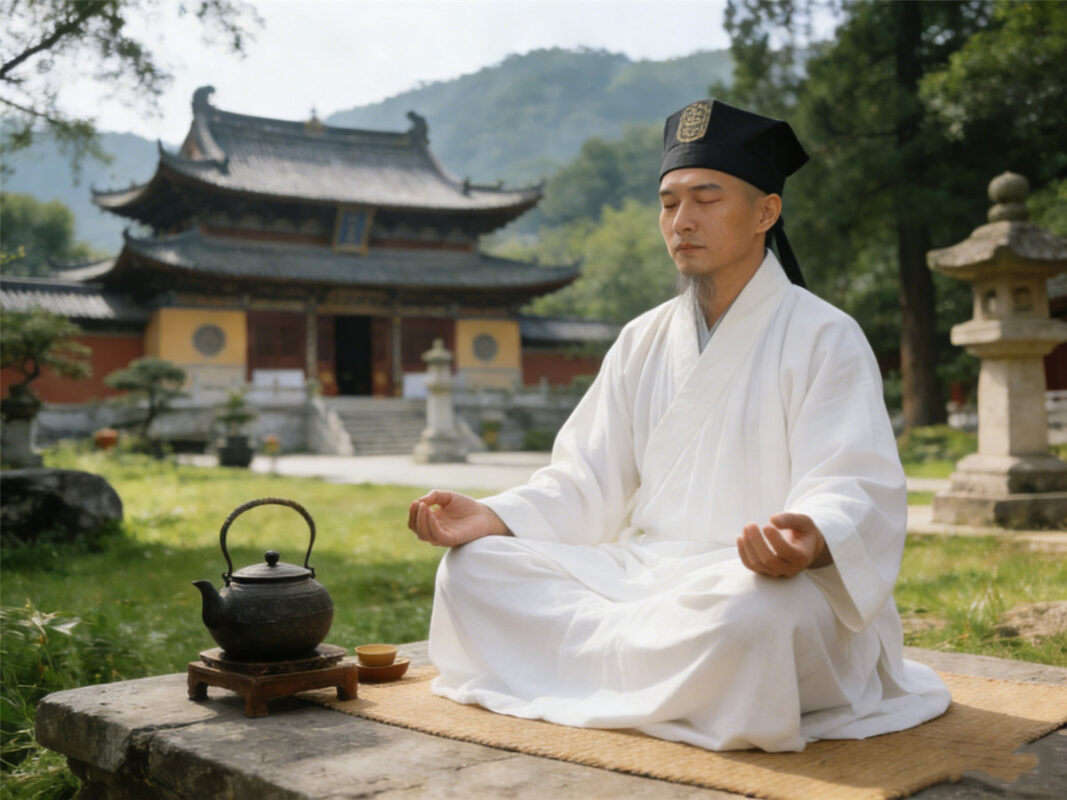
- Sitting in Forgetfulness (Zuowang): Letting go of discursive thought, releasing attachments to identity and desire, and simply resting in open awareness. This dissolves the mental agitation fueling stress.
- Inner Observation: Mindfully scanning bodily sensations without judgment, observing the flow of thoughts and emotions like clouds passing in the sky. This cultivates detachment from stress triggers and fosters somatic intelligence, recognizing tension early.
- Gentle Movement: Qigong & Tai Chi
- Flowing Forms: Practices like the “Eight Pieces of Brocade” (Ba Duan Jin) or Tai Chi sequences integrate breath, slow, deliberate movement, and focused intention. They unblock Qi stagnation, enhance body awareness, ground scattered energy, and induce a state of calm alertness. The movements embody Wu Wei – yielding yet powerful.
- Nature Immersion: Resonating with the Dao’s Manifestation
- Spending unstructured time in natural settings – forests, mountains, near water – facilitates a profound resonance (Ganying) between our internal state and the harmonious patterns of the natural world. This quiet contemplation helps regulate our biological rhythms and dissolves the artificial urgency cultivated by urban environments.
IV. Transforming Perception: The Daoist Art of Emotional Alchemy
Daoist psychology reframes our relationship to challenging emotions and thoughts, viewing them not as enemies but as energy in motion to be understood and integrated:
- Non-Identification & Witnessing: Learning to observe thoughts and feelings (“I am stressed”) without becoming them (“I am stress”). This shift from identification to witnessing creates crucial space, reducing the emotional charge and preventing reactivity.
- Working with the Five Elements (Wu Xing): Emotions are seen as natural expressions of elemental energies (Wood/Anger, Fire/Joy, Earth/Worry, Metal/Grief, Water/Fear). Stress arises when an element is excessive or deficient. Daoist practices aim to balance these elements within. For example, excessive worry (Earth imbalance) might be calmed by Metal practices (breathwork focusing on letting go).
- Embracing Impermanence & Non-Attachment: Recognizing that all states – including stress – are transient, flowing phenomena reduces the tendency to catastrophize or cling to discomfort. Cultivating gentle non-attachment (Wu Zhu) to specific outcomes lessens resistance and the attendant stress.
- Finding the Lesson in Turbulence: Challenges and stressors are viewed as opportunities for refinement, mirrors reflecting internal imbalances. Asking “What is this revealing about my attachments or resistance?” transforms stress from a threat into a teacher, fostering resilience and wisdom.
V. Integrating Wu Wei into Modern Life: Effortless Navigation of Complexity
The ultimate goal is not retreat but mastery – navigating the complexities of contemporary existence with the poise of Wu Wei:
- Prioritization as Alignment: Focus energy only on tasks truly aligned with core purpose and values (De). Ruthlessly eliminate or delegate non-essential demands. Ask: “Is this action in harmony with my true nature and the natural flow right now?”
- Yielding as Strategy: Recognize when forceful pushing is counterproductive. Practice strategic yielding – stepping back, allowing situations to settle, or finding the path of least resistance. Like water flowing around a rock, yielding often achieves the goal with less friction.
- Presence as Power: The greatest antidote to stress-induced rumination (past) or anxiety (future) is deep presence (Dang Xia). Cultivating moment-to-moment awareness anchors the Shen, improves decision-making, and reveals the inherent simplicity within complexity. Stress thrives in the absence of presence.
- Acceptance of Limits: Honor natural cycles of energy (daily, seasonal, life-stage). Respect the need for rest and recovery (Yin) as sacred, not lazy. Forcing activity during natural low periods creates significant stress and depletes Jing.
VI. Embodying the Dao: Cultivating a Sanctuary Within and Without
Sustaining this alignment requires creating environments and routines that consistently nurture our connection to the Daoist principles, transforming abstract philosophy into tangible daily experience. This is where mindful engagement with our surroundings and objects becomes a powerful practice. Dao crafts represent the tangible application of these principles. Objects crafted with mindfulness, honoring the inherent virtues (De) of natural materials – the grain in wood, the cool solidity of stone, the imperfect beauty of hand-thrown clay – carry the resonance of Wu Wei and Ziran. Choosing a simple, beautifully crafted tea bowl over mass-produced ceramics isn’t just aesthetic; it’s an invitation to presence during a daily ritual. Furniture designed with flowing lines and natural elements supports physical ease and reflects the harmony of nature. Integrating dao crafts into our living and working spaces serves as a constant, gentle reminder of simplicity, authenticity, and the beauty of the unforced. Similarly, contemplating or wearing dao jewelry—pieces crafted not merely for adornment but as talismans of intention, often incorporating natural stones, flowing metals, or symbols like the Yin-Yang or Taijitu—can function as powerful touchstones. Feeling the cool weight of a jade pendant, carved with symbols of harmony, resting near the heart center, can instantly draw awareness inward during moments of rising tension. A ring crafted from textured silver, reminiscent of flowing water, becomes a subtle prompt to embody fluidity and yield. These objects are not magical fixes; they are anchors, physical manifestations of the philosophy, helping to ground the scattered Shen and reconnect us with the quiet strength and enduring peace found at the center – the still point within the Dao’s eternal turning. Surrounding ourselves with these mindful expressions of dao crafts and carrying the intentionality of dao jewelry weaves the principles of harmony, presence, and resilient simplicity directly into the fabric of our lived reality, supporting the continuous journey back to our unburdened essence.