
Interesting Dao
Daoist Temple Architecture: Sacred Space Design
Nov
Among the enduring legacies of Chinese civilization, Daoist temple architecture stands as one of the most refined expressions of humanity’s dialogue with nature, spirit, and cosmos. Each temple, from the mist-shrouded sanctuaries on Wudang Mountain to the humble village shrines hidden in bamboo forests, is far more than a structure of stone and timber — it is a spatial manifestation of Daoist cosmology, designed to harmonize with the rhythms of heaven and earth. The Daoist temple is not built on the land but with it; it is not an interruption of nature but a continuation of it in architectural form.
As modernization reshapes skylines and redefines aesthetics, understanding the principles behind Daoist sacred design reveals something essential about how humans can inhabit the world without dominating it. To walk through a Daoist temple is to enter a world where geometry serves meditation, architecture channels breath, and design becomes a living language of the Way.
The following sections explore the philosophical foundations, structural logic, spatial symbolism, and artistic detail that make Daoist architecture both timeless and profoundly relevant today.
1. The Philosophical Foundations of Sacred Architecture
Daoist architecture arises from a worldview that regards all existence as an unfolding of the Dao (道) — the ineffable, self-generating principle underlying reality. Unlike other religious architectures that seek to dominate the skyline or assert divine authority, Daoist design seeks resonance and balance (和).
Harmony Between Heaven, Earth, and Humanity
The temple is conceived as a microcosm of the universe, linking heaven (天), earth (地), and humanity (人) in dynamic alignment. Every wall, courtyard, and axis line participates in this cosmological triad. The positioning of the temple within the landscape is never arbitrary; geomantic principles, known as fengshui (風水), determine the ideal relationship between mountain, water, and structure. A temple facing south, shielded by hills to the north and embraced by rivers or trees, symbolizes openness to life and protection from disorderly forces.
The Dao as Spatial Flow
The Dao is flow — invisible, continuous, and transformative — and so the architecture that honors it must breathe. The passageways, open courtyards, and layered roofs of Daoist temples are designed not merely for movement but for circulation of qi (氣), the vital energy believed to animate all things. The temple’s arrangement ensures that qi enters gently, flows through spaces of purification and contemplation, and exits unobstructed. This circulation mirrors the inner alchemy of Daoist meditation, in which breath, spirit, and body harmonize as one.
2. The Structure and Spatial Hierarchy of a Daoist Temple
Daoist temples, or daoguan (道觀), typically unfold along a carefully organized axis that embodies both cosmological hierarchy and spiritual progression.
The Axis of Ascent
Most Daoist temples are composed of three or more main halls arranged along a central north-south axis. Visitors enter through the mountain gate, pass through a sequence of courtyards and side halls, and ascend toward the central sanctuary where the principal deity resides. This progression symbolizes a journey from the mundane to the celestial — from the realm of dust to the realm of spirit.
At the outer gate, guardians such as the Four Heavenly Kings or protective generals ward off malevolent energies. The intermediate courtyards often contain subsidiary shrines to immortals, sages, or celestial officials, each representing a specific domain of Daoist cosmology. Finally, the main hall — often dedicated to the Three Pure Ones (Sanqing 三清) — marks the culmination of spiritual ascent, the point at which the human visitor symbolically approaches union with the Dao.
Integration of Nature and Architecture
Unlike the rigid symmetry of imperial palaces, Daoist temples often follow the natural contours of the landscape. Buildings may appear irregular or asymmetrical, yet this is deliberate — it reflects the Daoist principle of ziran (自然), or naturalness. Paths may curve gently around ancient rocks, steps may rise unevenly with the mountain, and roofs may be offset to preserve trees that predate the structure. To walk through such a temple is to feel nature guiding one’s pace and perception, reminding visitors that harmony arises not from control but from adaptation.
3. Symbolism and the Cosmic Blueprint
Every feature of Daoist temple architecture conveys a symbolic language rooted in cosmology, mythology, and metaphysics. These symbols are not decorative but functional — they participate in maintaining cosmic order.
The Five Directions and the Flow of Qi
Daoist temples are often oriented to express the Five Directions (五方) — east, south, west, north, and center — each associated with specific elements, colors, and deities.
- East corresponds to wood, spring, and renewal;
- South to fire, summer, and vitality;
- West to metal, autumn, and transformation;
- North to water, winter, and stillness;
- Center to earth, balance, and stability.
The spatial arrangement ensures that energy flows through these elemental zones in harmony, just as the body’s inner qi must circulate freely.
The Temple as a Cosmic Diagram
Daoist architecture can be read as a three-dimensional mandala, mapping invisible principles onto physical space. Roof ridges represent the heavens arching above, while courtyards signify earthly openness. The vertical dimension — ascending terraces or layered halls — corresponds to spiritual refinement. Even the colors and materials used are intentional: red for vitality, gold for illumination, and green tiles for renewal.
In many temples, inscriptions carved into beams or gates remind the visitor of cosmic truths: impermanence, unity, and the ever-returning Way.
4. Architectural Forms and Aesthetic Principles
The beauty of Daoist temples lies in the subtle tension between stillness and movement, symmetry and spontaneity, emptiness and fullness.
Roofs and Elevation
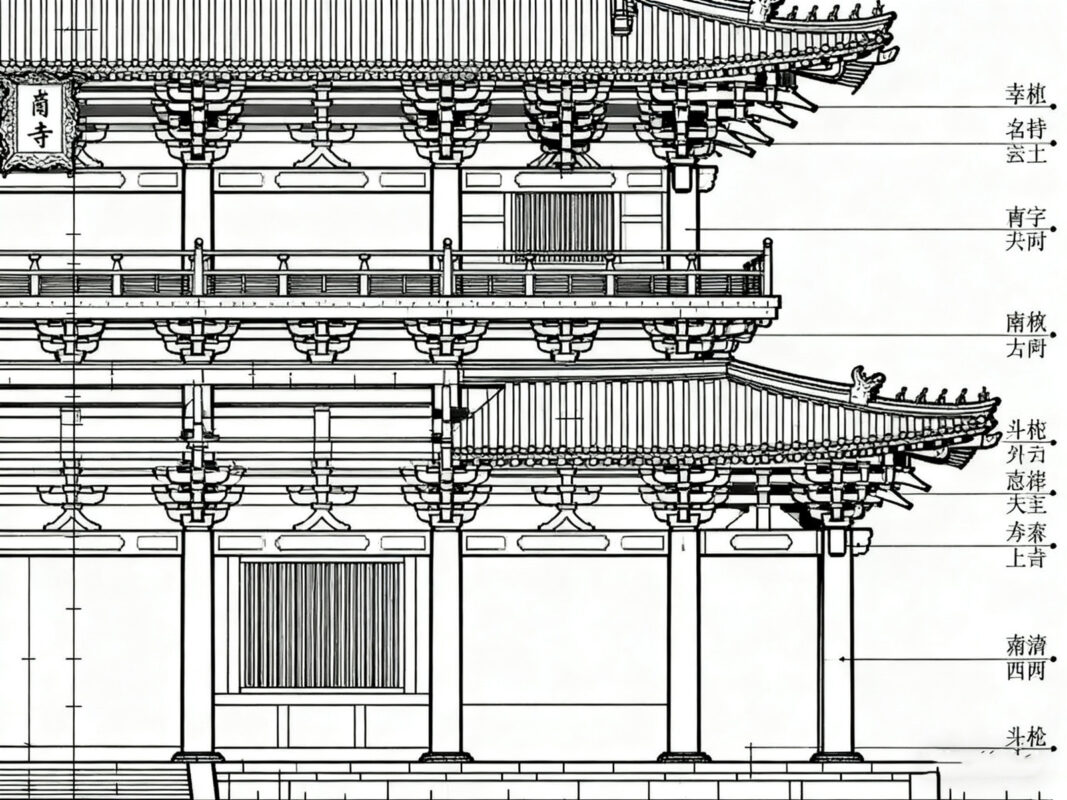
Daoist roofs, with their elegantly sweeping curves, are perhaps the most recognizable feature of Chinese sacred architecture. These roofs are not merely aesthetic; their upward arcs are believed to deflect evil spirits and lift the energy of the structure skyward. The multi-tiered eaves symbolize layered heavens, while their rhythmic curvature echoes the undulating motion of clouds and mountains.
Courtyards and Thresholds
The use of courtyards (yuan 院) introduces breathing space between halls. Each courtyard functions as both a transitional and contemplative zone — a pause that allows visitors to recalibrate their senses before entering the next level of sanctity. Stone paving patterns often symbolize water flow, guiding the mind toward quiet reflection.
Thresholds between spaces are carefully designed: low steps slow the body, high door frames require mindfulness when crossing, reminding visitors to leave worldly concerns behind.
Material Harmony
Timber, stone, clay, and bronze are chosen not merely for durability but for their energetic resonance. The scent of aged wood, the cool texture of stone, the warmth of terracotta tiles — all engage the senses in ways that awaken presence.
This sensitivity to material extends beyond construction; even the choice of pigments in murals or lacquered altars reflects the principle of harmony between substance and spirit.
5. Ritual Function and Sacred Experience
Architecture in Daoism is inseparable from ritual performance. The temple exists not simply to be admired but to host cycles of ceremony, meditation, and offering that sustain cosmic balance.
Spaces for Transformation
Each section of the temple corresponds to a stage in spiritual refinement. The outer courtyard welcomes the uninitiated; the middle court prepares the practitioner; the inner sanctuary manifests communion with the divine. When incense rises through open skylights or bells resonate across valleys, the architecture itself becomes a medium through which human intention merges with cosmic rhythm.
Acoustics and Atmosphere
Daoist architects paid careful attention to sound and silence. The placement of wooden floors, hollow beams, and stone walls produces resonances that amplify chanting and percussion, transforming ritual sound into a tangible vibration felt throughout the body. Likewise, natural sounds — wind rustling bamboo, water dripping from eaves — blend seamlessly into the ritual landscape, reminding practitioners that the Dao encompasses both human and natural music.
Light and Shadow
Lighting is equally symbolic. Sunlight enters courtyards at measured angles, casting transient patterns that mirror the cycles of yin and yang. The interplay of dim interiors and bright courtyards evokes the alternation between emptiness and manifestation, meditation and revelation.
6. Artistic Ornamentation and Craftsmanship
The Daoist temple is an encyclopedia of sacred craftsmanship, where every carving, mural, and ornament transmits philosophical meaning.
Iconography and Symbolic Motifs
Dragons and phoenixes soar across roof tiles, representing transformation and cosmic power; cranes and deer appear in murals, symbolizing longevity and peace; the bagua (八卦), or eight trigrams, often adorns gates and ceilings, reminding visitors of the patterns underlying existence.
The Role of Craft in Spiritual Transmission
The artisans who built Daoist temples were not merely laborers but participants in a sacred act. Every chisel stroke, brush mark, or tile placement was a meditation on order and impermanence. The geometry of lattice windows, for example, is designed to filter light in patterns that mirror cosmic harmony.
Such dedication to detail connects architecture to Daoist internal practice — precision without rigidity, beauty without attachment. It is here that contemporary efforts to revive Daoist artistry find resonance. Today, initiatives like DaoCrafts.com are rediscovering traditional design principles and merging them with modern craftsmanship, demonstrating how ancient spatial philosophies can inform sustainable and spiritual architecture in the 21st century.
Preservation Through Adaptation
Restoration projects must do more than preserve stone and wood; they must retain the energetic integrity of sacred space. When artisans restore faded murals or rebuild temple halls, their task is not replication but reanimation — ensuring that the structure continues to breathe with the rhythm of the Dao.
7. Daoist Architecture in the Modern World
As modern skylines rise higher and technology dominates human experience, Daoist temple architecture offers a counterpoint — a vision of building that respects the invisible as much as the visible.
The Challenge of Urbanization
Urban development has surrounded once-secluded temples with roads, high-rises, and noise. The spiritual isolation that once defined sacred space is harder to sustain. Yet, even within cities, new Daoist temples are being designed with contemporary materials while retaining ancient principles: curved glass panels that mimic mountain silhouettes, courtyards designed as air sanctuaries amid dense construction, and digital lighting systems programmed to follow lunar cycles.
Revival of Sacred Design Thinking
Architects and spiritual practitioners are increasingly studying Daoist design to inspire sustainable and biophilic architecture — buildings that interact with their environment rather than dominate it. Concepts like permeability, balance, and flow have become central to ecological design movements worldwide, echoing the Daoist understanding that space must serve both body and spirit.
Living Architecture as a Way of Being
Ultimately, Daoist temple architecture teaches that sacred space is not confined to temples alone. Any structure — a home, workshop, or studio — can embody Daoist principles when designed with attentiveness to balance, rhythm, and the quiet presence of nature. The true sacred architecture, therefore, is the one that makes life itself a meditation: walls that breathe, light that heals, and spaces that awaken stillness within.
The enduring beauty of Daoist temple architecture lies in its humility and coherence. It does not proclaim power but reveals harmony; it does not impose shape upon the world but discovers the shape that the world already offers. In its stones and curves, one senses the pulse of an ancient wisdom still capable of guiding the modern mind.
To enter such a temple — to stand beneath the sweeping eaves, to hear the wind pass through wooden beams — is to remember that architecture, at its most sacred, is not the art of building walls, but the art of creating space where the Dao can breathe.