
Dao Story, Interesting Dao
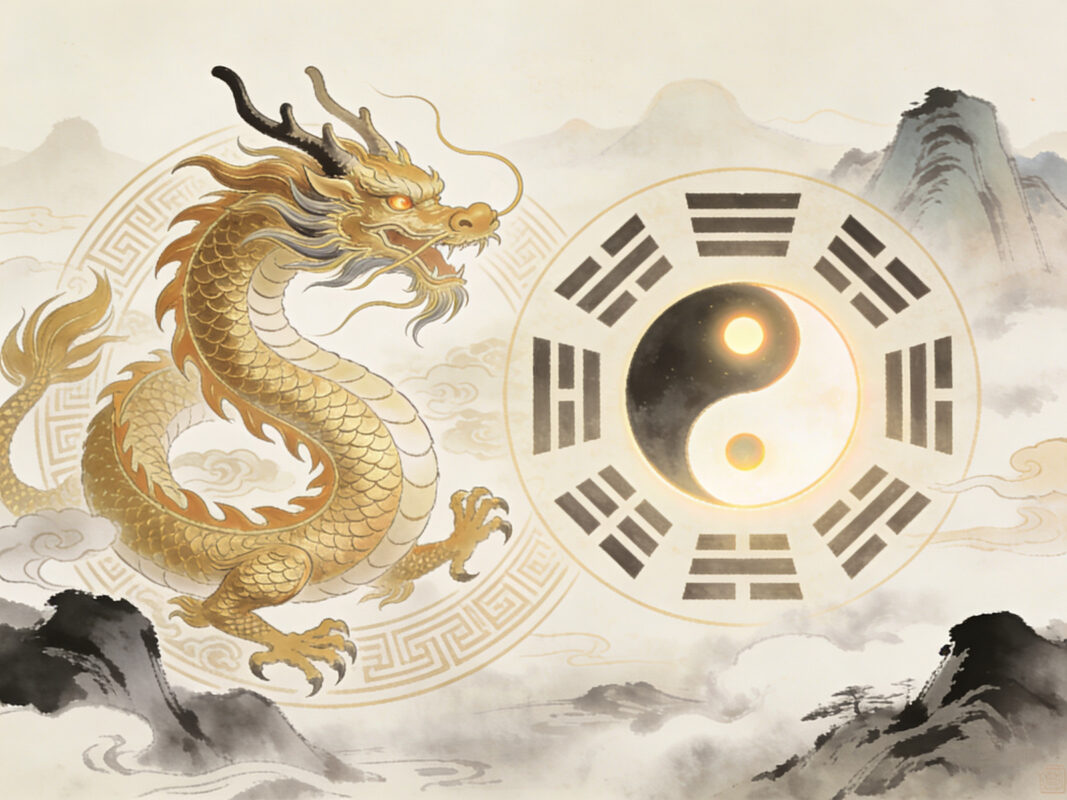
Dragon Symbolism in Daoist Cosmology
Dec
1. The Celestial Rising
The story begins high above the misted peaks of Mount Kunlun, where early Daoist sages claimed the veils between realms grew thin enough for the dragon to cross from the invisible world of qi into the visible world of form, and although many myths describe dragons swooping through storm clouds or plunging into oceans, the scholars who shaped early Daoist cosmology insisted that dragons did not simply inhabit the natural world but embodied its deepest rhythms, in the same way that a single breath connects the inner body to the outer sky. In this tradition, the dragon rose not as a mere creature of legend but as a symbol of the cosmic interface, a living bridge that linked the spontaneous transformations of the Dao to the patterned cycles humans could see and understand.
2. The Breath of the Dao
2.1 The Primordial Exhalation
Daoist texts speak of the original qi as a swelling, slowly rotating breath that held neither form nor boundary, and from this subtle field the dragon appears as the first sign that energy has begun to coagulate into direction, movement, and intent. The early sages described the dragon as the shape of formlessness, an energetic ripple that hinted at the Dao’s invisible architecture, so when they invoked dragons in ritual or meditation they were not imagining a theatrical creature but rather attuning themselves to the way energy rises, coils, and disperses before reforming again.
2.2 The Living Current
Within this layered cosmology, the dragon’s body was often interpreted as a map of the energy pathways of heaven and earth, and its long, winding form resembled rivers, thunder paths, and even the spiraling eddies inside mountain valleys, which made the dragon’s presence a reminder that flow is the fundamental language of the universe. Because the Daoist worldview rarely divides spirit from matter, the sages observed the motion of clouds and streams as if reading the movements of a dragon, believing that by understanding those patterns they could understand the shifting intentions of the cosmos itself.
3. The Celestial Bureaucracy and the Dragon Lords
3.1 Guardians of the Four Directions
Over time, Daoist cosmology developed a structured system known as the Celestial Bureaucracy, a spiritual hierarchy through which cosmic order was maintained, and within this vast administration the Dragon Kings held important roles as regulators of the seas, the rains, and the seasonal cycles that supported all forms of life. The Dragon Kings of the East, South, West, and North each governed a quadrant of the world, serving as extensions of the Dao’s transformative power, and their courts were said to resemble imperial administrations, complete with ministers, scribes, and envoys who executed celestial mandates. When drought or flood threatened human communities, Daoist priests petitioned these Dragon Kings not because dragons were whimsical supernatural beasts but because they personified the lawful movement of elemental forces.
3.2 Dragons as Moral Indicators
In many accounts, dragons also responded to the ethical balance of human society. A community that acted with integrity, harmony, and reverence for natural cycles was said to receive gentle rain and favorable tides, while a community overcome by greed or political chaos might witness storms, strange animal behavior, or prolonged drought. These phenomena were not viewed simply as punishments but as reflections of a disrupted relationship between humanity and the larger web of qi, so the dragon’s appearance or withdrawal became a diagnostic tool for understanding spiritual imbalance.
4. The Dragon and the Human Body
Daoist inner alchemy maps the human body as a microcosm of the universe, and in that intimate landscape the dragon takes on an internal dimension, especially within practices such as Neidan (Internal Alchemy), where practitioners imagine the rising of a luminous dragon within the lower abdomen as a sign that inner qi has awakened and begun to circulate. This internal dragon is described as coiling around the Dantian, swimming up the spine’s channels, and finally reaching the crown, where its release symbolizes the merging of personal consciousness with the vast currents of celestial qi. Teachers often warned students that this dragon should never be forced into motion, because it responds only to relaxed intention, steady breath, and a clear mind, showing again how Daoism values natural unfolding over aggressive effort.
5. Water, Thunder, and the Dragon’s Dual Nature
5.1 The Water Realm
In classical sources, the dragon’s strongest affiliation is with water, and this connection extends far beyond physical oceans or rain; it includes the entire spectrum of Yin energy, such as emotional depth, hidden memory, and the quiet strength found in stillness. The dragon plunging into water represents a return to the primordial womb of existence, the phase of creation when all things have dissolved into potential, and in many stories a sage seeking deeper wisdom follows the dragon into the water not to conquer it but to learn how to listen to the subtle messages carried in its depths.
5.2 The Thunder Path
Yet the dragon also commands thunder, a realm of Yang energy defined by sudden breakthroughs, loud declarations, and the catalytic spark of transformation, so Daoist storytellers often describe the dragon leaping from dark lakes into the sky during storms as a way to illustrate how Yin and Yang do not oppose each other but rather alternate and complete one another in continuous cycles. A practitioner who studies these two dragon realms learns that power lies in balancing quiet introspection with decisive action, much like a dragon that rests in the deep before rising with a roar.
6. The Dragon as Cultural Memory
Across the centuries, the dragon grew into a symbol of collective cultural memory, especially in communities that saw themselves shaped by rivers, mountains, and monsoon cycles, and because these natural forces governed survival, the dragon became a reminder that humanity thrives only when it pays attention to the environment’s shifting signals. The dragon also appeared in architecture, calligraphy, and ritual objects not as decoration but as a mnemonic device that encouraged people to remember older understandings of harmony, seasonal rhythm, and the interdependence of all forms of life. For Daoist storytellers, repeating tales of dragons was a way to keep cosmological knowledge alive, ensuring that each generation understood how human affairs fit within a much larger, living system.
7. The Dragon in Ritual and Mythic Storytelling
7.1 Ritual Dialogue with the Dragon
During formal Daoist rituals, priests often used written talismans, rhythmic chanting, and symbolic gestures to communicate with dragon spirits, and these were not superficial displays but carefully structured rites designed to align human intent with cosmic cycles. The priest’s movements traced the dragon’s serpentine arcs, and the chants mirrored the rolling thunder of the dragon’s ascent, so the ritual itself became a temporary embodiment of the dragon’s movement through space. When performed correctly, participants felt as though the boundary between the ritual hall and the celestial realm had briefly thinned.
7.2 Stories Passed Through Generations
Myths about dragons guiding emperors, protecting wandering hermits, or teaching secret breathing methods were often less about literal encounters and more about helping listeners imagine what it feels like to synchronize with the Dao, and these stories used dramatic imagery because the human mind grasps meaning more easily through narrative than abstraction. In this sense, legendary dragons served as teaching tools, each tale offering a practical lesson hidden behind cosmic imagery: patience, humility, timing, trust in natural change, and the refusal to cling to rigid forms.
8. The Eternal Coiling: A Closing Reflection
As the story of Daoist cosmology unfolds across centuries of practice, scholarship, and quiet observation of nature, the dragon emerges as one of its most enduring symbols, not because it is exotic or spectacular but because it reflects the fundamental truth that reality is always in motion, always coiling and uncoiling in patterns too large for any single perspective to capture. To see the world through the dragon’s eyes is to recognize that creation and dissolution are part of a single, ongoing cycle, and that all beings participate in a shared circulation of qi that connects sky, earth, and the inner landscape of the human spirit. For those who continue to study the Dao today, whether through classical texts, meditative practice, or contemporary interpretations of traditional crafts, the dragon remains a guide that leads from visible form into the subtle realms that shape it, and this story, like many others, continues to find new life in places that keep Daoist symbolism alive, including communities and makers aligned with the spirit of sites such as daocrafts.com.