
Interesting Dao
Feng Shui Principles: Daoist Environmental Harmony
Feb
The quest for a balanced, harmonious, and prosperous life is a universal human aspiration. For millennia, cultures across the globe have developed intricate systems to understand the relationship between humanity and its environment. Among the most profound and enduring of these traditions is Feng Shui, an ancient Chinese art and science deeply rooted in Daoist philosophy. Far more than mere interior decoration or superstitious placement of objects, Feng Shui offers a sophisticated framework for aligning our living and working spaces with the natural flow of energy, or Qi, thereby fostering profound environmental harmony. This philosophy transcends aesthetics; it is a practice aimed at cultivating well-being, enhancing fortune, and nurturing a deep sense of peace by understanding and respecting the subtle forces that shape our world. At its core, Feng Shui is the practical application of Daoist principles to our built environment, seeking to create spaces that resonate with the rhythms of nature and the universe itself.
I. The Daoist Foundation: Qi, Yin-Yang, and the Way
To truly grasp Feng Shui, one must delve into its philosophical bedrock: Daoism. Daoism, centered on the Dao or “The Way,” emphasizes living in accordance with the natural order, embracing simplicity, spontaneity, and the inherent flow of the universe. Its core tenets provide the essential vocabulary and concepts for Feng Shui practice.
- Qi (Chi): This vital life force energy permeates everything – people, landscapes, structures, and the spaces within them. Feng Shui seeks to cultivate the smooth, unimpeded flow of beneficial Qi while deflecting or transforming Sha Qi (destructive or stagnant energy). The quality and movement of Qi within a space directly influence the health, fortune, and vitality of its occupants. Imagine Qi as the breath of a place; where it flows freely and gently, life flourishes; where it is blocked or turbulent, stagnation and disharmony arise.
- Yin and Yang: This fundamental duality represents the dynamic interplay of complementary opposites – dark and light, passive and active, feminine and masculine, earth and heaven. True harmony arises not from the dominance of one force, but from their balanced, dynamic interaction. Feng Shui analysis constantly assesses the Yin-Yang equilibrium within a space, adjusting elements to restore balance where it is lacking. A room flooded with harsh light (excessive Yang) might need softening elements (Yin), just as a dim, cavernous space (excessive Yin) might crave energizing light and activity (Yang).
- The Five Elements (Wu Xing): Wood, Fire, Earth, Metal, and Water form a cyclical system of transformation and interaction (Generating and Controlling cycles). Each element embodies specific qualities, colors, shapes, and associations. Feng Shui uses this system to diagnose elemental imbalances within a space and prescribe adjustments – introducing representations of a lacking element or moderating an overly dominant one – to restore elemental harmony and support desired life aspects. The interdependence of these elements reflects the Daoist view of the interconnectedness of all things.
Understanding these principles is paramount. Feng Shui is not about arbitrary rules; it’s about applying the wisdom of the Dao – observing natural patterns, respecting energetic flows, and seeking balance – to create environments that support and nurture human life.
II. Mapping the Energy: The Bagua and Environmental Assessment
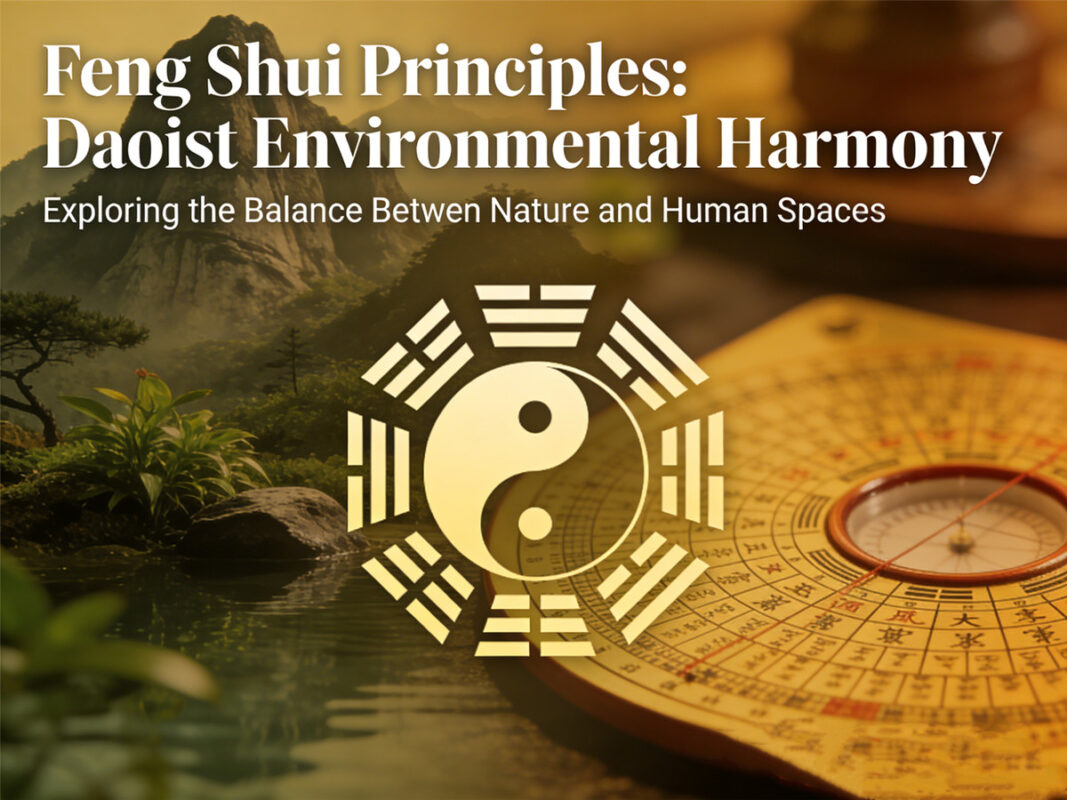
A crucial tool for applying Daoist principles spatially is the Bagua map. This octagonal grid, often superimposed over a building’s floor plan, divides any space into nine key life areas, each corresponding to specific aspects of human experience such as Wealth, Fame, Relationships, Family/Health, Children/Creativity, Knowledge, Career, Helpful People/Travel, and the central Tai Qi representing overall health and unity.
- Aligning the Bagua: Properly aligning the Bagua (typically using the main entrance as the reference point) allows the practitioner to diagnose which areas of a space correspond to which life aspects. Imbalances or blockages in a specific Bagua sector can manifest as challenges in the related life area. For instance, a cluttered, neglected space in the Wealth area might correlate with financial stagnation.
- Compass School Nuances: While the basic Bagua provides a framework, classical Compass School Feng Shui incorporates precise directional measurements using a Luo Pan (geomantic compass). This accounts for the directional influences of the eight trigrams and the quality of Qi associated with specific compass bearings, adding another layer of depth and personalization to the assessment based on the property’s facing direction and the occupants’ birth data. This precision reflects the Daoist attention to the unique characteristics of each moment and location.
- Form School Observation: Complementing the Bagua and compass readings is the Form School approach. This involves keen observation of the external and internal environment – the shapes of surrounding landforms or buildings (mountain dragon), the flow of water (water dragon), the arrangement of furniture, and the presence of symbolic forms. Sharp angles pointing towards a building (creating Sha Qi) or a supportive hill behind it (offering protective embrace) are classic Form School considerations, emphasizing the direct impact of physical shapes on energy flow. It embodies the Daoist principle of learning from nature’s forms and patterns.
A comprehensive Feng Shui assessment weaves together these approaches – Bagua application, directional analysis, and form observation – to create a holistic picture of the energetic landscape.
III. Harmonizing with Nature: Integrating the Five Elements
The Five Elements theory provides a powerful language for understanding and adjusting the energetic qualities within a space. Each element brings its unique energy and influences specific life areas:
- Wood: Symbolizes growth, vitality, creativity, and family. Represented by vertical lines, columnar shapes, the color green, and living plants. Its energy is expansive and upward-moving. An abundance of Wood can foster new beginnings and flexibility; a lack might stifle growth.
- Fire: Represents passion, fame, illumination, and dynamic activity. Symbolized by triangular shapes, red and strong purple hues, lighting (especially candles and open flames), and images of the sun or heat. Its energy is radiant and ascending. Balanced Fire brings warmth and recognition; excessive Fire can lead to burnout or conflict.
- Earth: Signifies stability, nourishment, grounding, and relationships. Represented by square shapes, flat surfaces, earthy colors (yellows, browns, terracotta), ceramics, and crystals. Its energy is stabilizing and centering. Earth provides the foundation; too much can lead to stagnation, too little to instability.
- Metal: Embodies precision, clarity, efficiency, and helpful people. Symbolized by circular and oval shapes, white and metallic colors, and actual metal objects. Its energy is contracting and consolidating. Metal brings focus and structure; an excess can create coldness or rigidity.
- Water: Represents flow, wisdom, communication, and career. Symbolized by wavy lines, black and deep blue hues, mirrors, and actual water features. Its energy is descending and flowing. Water supports reflection and adaptability; uncontrolled Water can signify loss or insecurity.
Achieving Elemental Balance: Feng Shui practice involves diagnosing the elemental composition of a space and its Bagua areas. Is one element overwhelmingly dominant? Is another conspicuously absent? The goal is to create a dynamic equilibrium where the elements support and regulate each other, fostering harmony across all life aspects. Introducing a Water feature might cool an overly Fiery Fame area, while adding Earthy ceramics could ground a space dominated by expansive Wood energy in the Family sector. This careful calibration mirrors the Daoist pursuit of balance within the natural world.
IV. Practical Application: Creating Harmony in Home and Workspace
Moving from theory to practice, how do we apply these Daoist principles to create tangible harmony? It involves conscious design choices informed by Qi flow, Yin-Yang balance, and the Five Elements.
- Optimizing Qi Flow: The primary goal is to ensure smooth, meandering Qi throughout the space. This means:
- Decluttering: Removing physical obstructions is paramount. Clutter represents stagnant Qi and impedes the free movement of energy, often creating mental and energetic blockages. A clear space allows Qi to circulate freely.
- Functional Layouts: Arranging furniture to facilitate easy movement without sharp corners pointing at seating areas (creating poison arrows or Sha Qi). Ensuring doors open fully without obstruction and pathways are clear reflects the Daoist value of effortless movement (Wu Wei).
- Entrance Harmony: The main entrance, or Ming Tang, is considered the “mouth of Qi.” A welcoming, well-lit, uncluttered entrance invites beneficial Qi into the home. A solid door in good repair and a clear pathway leading to it are essential.
- Balancing Yin and Yang: Assess the energetic quality of each room. A home office might need more Yang energy (light, activity, vibrant colors) to support focus and productivity, while a bedroom requires more Yin (softer lighting, calming colors, gentle textures) to promote rest and rejuvenation. The balance is never static but shifts according to the room’s purpose and the time of day.
- Strategic Elemental Enhancement: Based on the Bagua and elemental diagnosis, introduce specific element representations to enhance or moderate energies. A metal bowl in the Helpful People area, a healthy green plant in the Family/Health sector, or a small Earth-colored rug in the Relationship corner are targeted adjustments. Placement should feel intentional yet natural within the overall décor.
- The Power of Symbolism: Daoist thought recognizes the power of symbols to influence Qi. Meaningful artwork, representations of nature, and culturally resonant symbols (like the Yin-Yang symbol itself or images of mountains for stability) can subtly enhance the desired energy of a space when placed thoughtfully.
These practical steps transform abstract principles into a lived experience of environmental harmony.
V. Beyond Static Space: Time and the Art of Placement
A truly holistic Daoist perspective acknowledges that harmony is not static; it evolves with time. Feng Shui incorporates temporal dimensions through systems like Flying Star Feng Shui (Xuan Kong).
- The Influence of Time: Flying Star Feng Shui calculates how astrological energies, represented by stars associated with the Five Elements, shift and move through a building’s sectors over specific time periods (years, months). Each star brings its unique influence – some beneficial, some challenging.
- Dynamic Adjustments: Understanding these annual cycles allows for proactive adjustments. For example, if the current annual Flying Star combination brings challenging Fire energy to the Wealth sector, one might introduce representations of the Water element (which controls Fire in the destructive cycle) to mitigate potential issues like unexpected expenses or financial disputes. Conversely, if a beneficial Water star flies into the Career area, enhancing that sector with Water or Metal elements (which generate Water) could support professional opportunities. This reflects the Daoist understanding of constant change and the need for adaptability.
- Aligning with Cycles: This temporal aspect encourages a practice of ongoing engagement with one’s environment, aligning placements and activities with the prevailing energies of the time, much like a farmer planting seeds according to the seasons. It adds a layer of depth and responsiveness to the practice.
Recognizing the dynamic nature of Qi and its interaction with time deepens our ability to foster enduring harmony.
VI. Contemporary Resonance: Integrating Daoist Harmony into Modern Life
While rooted in antiquity, Feng Shui’s principles resonate powerfully with contemporary concerns about well-being, sustainability, and our relationship with the environment. Integrating Daoist environmental harmony into modern life is both feasible and deeply rewarding.
- Mindful Design: Modern architecture and interior design increasingly embrace principles that align with Feng Shui – maximizing natural light, using sustainable materials (Earth element), incorporating biophilic design (bringing nature in – Wood element), and creating open, flowing floor plans that facilitate Qi movement. These choices inherently support health and reduce stress, aligning with the core aim of Feng Shui.
- Wellness and Sustainability: The focus on clean, unobstructed spaces (decluttering), good air quality (Qi), and connection to nature mirrors contemporary wellness trends. Feng Shui’s emphasis on respecting the natural environment and creating energy-efficient spaces (avoiding drafts which scatter Qi, optimizing natural light) aligns with sustainable living principles. It encourages us to see our homes not just as shelters, but as living ecosystems.
- A Holistic Approach: Modern Feng Shui is less about rigid dogma and more about applying core Daoist principles – balance, flow, connection to nature, and mindful intention – in ways that suit individual lifestyles and contemporary aesthetics. It’s about creating spaces that feel right, that support our endeavors, and that provide sanctuary from the external world. The practice cultivates a heightened awareness of our surroundings and our interaction with them.
- Intentional Curation: The final touch often involves selecting objects that resonate with personal meaning and contribute positively to the space’s energy. This is where the artistry of placement meets personal expression. For those seeking authentic pieces imbued with the spirit of these ancient principles, exploring carefully curated Feng Shui accessories can be meaningful. Dao crafts, particularly those inspired by the natural world and traditional symbolism, can serve as beautiful and energetically supportive elements within a harmonized space. Discover a collection designed with intention at daocrafts.com, where the essence of Daoist harmony is translated into tangible form for the modern home.
The timeless wisdom of Feng Shui, guided by Daoist philosophy, continues to offer invaluable insights for creating environments that nurture, inspire, and harmonize with the fundamental energies of life. It is a practice of continuous learning, observation, and mindful adjustment, leading us towards a deeper sense of peace and alignment within our surroundings.