
Dao Book Introduction, Interesting Dao
Gender Dynamics in Historical Daoist Texts
Jan
The Flowing Foundation: Daoism’s Core Principles and Gender
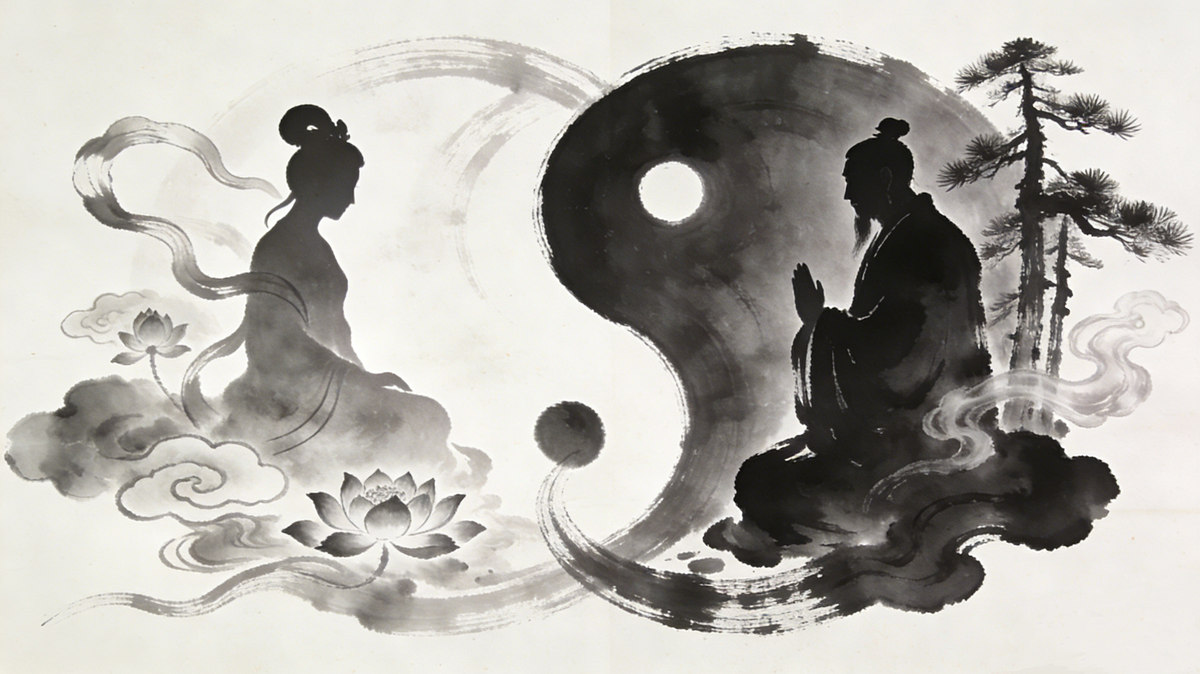
Daoist philosophy, emerging from the profound depths of ancient Chinese thought embodied in texts like the Daodejing (道德經) and the Zhuangzi (莊子), presents a worldview fundamentally rooted in dynamic balance, complementary forces, and the ceaseless flow of the Dao (道) – the ineffable source and principle of all existence. Central to this cosmology is the concept of Yin-Yang, representing the interdependent, ever-transforming duality inherent in the universe: Yin (often associated with receptivity, darkness, earth, water, and the feminine) and Yang (often associated with activity, light, heaven, fire, and the masculine). Crucially, neither is superior; both are essential, perpetually giving rise to and containing the seed of the other within a harmonious whole. This foundational framework suggests a potential space for understanding gender beyond rigid hierarchies, viewing masculine and feminine energies as complementary expressions of the universal life force rather than oppositional categories locked in struggle. The ideal state, mirroring the Dao itself, is one of fluid equilibrium, where apparent opposites coalesce into generative unity.
Early Echoes: Femininity, Power, and the Foundational Texts
The Daodejing, traditionally attributed to Laozi, offers some of the most striking and frequently cited passages regarding the valorization of qualities traditionally coded as feminine. It repeatedly employs potent feminine metaphors to describe the Dao’s nature and the efficacy of the sage-ruler. The Dao is likened to the “mother of the ten thousand things” (Chapter 25), the “valley spirit” that is “never exhausted” (Chapter 6), and the “mysterious female” whose “gateway is the root of heaven and earth” (Chapter 6). The text extols the virtues of receptivity (Chapter 15), softness overcoming hardness (Chapter 36, 43, 78), yielding as a strategy for ultimate influence (Chapter 22, 66), and the generative power of emptiness (Chapter 11). While not explicitly a feminist treatise, its consistent elevation of Yin-associated qualities – quietude, humility, nurturing, and intuitive wisdom – provided a powerful counter-narrative to the prevailing Confucian patriarchal structures that emphasized Yang virtues like dominance, rigidity, and overt control. The Zhuangzi, with its celebration of transformation, relativity, and the dissolution of fixed categories, further destabilizes conventional notions. Through parables like the “Butterfly Dream” and stories of gender-fluid beings and sages who transcend physical form, it implicitly questions the absolute significance of biological sex and social gender roles, pointing towards a state of being where such distinctions dissolve in the unity of the Dao.
Embodied Practice: Women in Early Daoist Communities and Priesthood
Historical evidence reveals that women played significantly more prominent and respected roles within early Daoist religious movements than in contemporaneous mainstream Chinese society. During the Han dynasty and the subsequent Period of Disunity, women were not merely passive adherents but active practitioners, teachers, and ritual leaders. The Tianshi Dao (Way of the Celestial Masters), one of the earliest organized Daoist religious communities, established a remarkably egalitarian structure. It recognized female libationers (nü jijiu 女祭酒), women who held positions of spiritual and administrative authority equal to their male counterparts, responsible for leading rituals, instructing communities, and managing registers. This institutionalized role granted women significant religious autonomy and social standing. Furthermore, texts associated with Shangqing (Highest Clarity) and Lingbao (Numinous Treasure) traditions, which emerged later, often featured divine revelations received by female mediums and adepts. Figures like Wei Huacun (魏華存), revered as a founding matriarch of the Shangqing lineage, exemplify the venerated status attainable by women who achieved spiritual mastery. These traditions suggest a space where female spiritual authority was not only acknowledged but actively cultivated, grounded in the belief that women possessed equal capacity for achieving union with the Dao.
Cosmology and Complication: Yin-Yang, Alchemy, and Patriarchal Infiltration
While the Yin-Yang framework offered a potential model for gender complementarity, its historical interpretation within Daoist contexts was not immune to the pervasive patriarchal norms of imperial China. Over time, particularly within certain alchemical traditions (both Waidan 外丹 external alchemy and Neidan 內丹 internal alchemy) and later sectarian developments, the symbolic interplay of Yin and Yang could be mapped onto biological sex in ways that introduced hierarchy. Internal alchemy (Neidan), which uses the body as a crucible for spiritual transformation, often employed complex sexual and gender symbolism. While aiming for the harmonious integration of Yin and Yang energies within the individual adept to create the immortal embryo, the underlying metaphors sometimes portrayed the feminine (Yin, Kan-water) as a passive substance to be “refined” or “controlled” by the masculine (Yang, Li-fire). Texts might instruct male practitioners to “guard the Yang” and avoid the perceived dangers of excessive Yin (often associated with sexual energy or emotional leakage), subtly reinforcing a bias towards Yang. Furthermore, the increasing institutionalization of Daoism, seeking legitimacy within imperial structures, often led to the adoption of Confucian social models, gradually marginalizing the earlier, more prominent roles for women within formal religious hierarchies, though female practice and lay devotion persisted.
Alchemical Androgyny and Transcendent Unity: Moving Beyond Duality
A profound counter-current within Daoist thought, particularly evident in internal alchemy (Neidan) but resonating throughout its mystical core, is the concept of transcending gender duality altogether. The ultimate goal of the alchemical process is not the victory of Yang over Yin, nor even their perfect external balance, but the creation of a unified, transcendent self that embodies the primordial unity preceding the division into Yin and Yang. This state is often described using terms like the “Golden Elixir” (jindan 金丹) or the “Sacred Embryo” (shengtai 聖胎), symbolizing a new, immortal being born within the practitioner. Achieving this requires the adept, regardless of biological sex, to cultivate and integrate fully the Yin and Yang energies within their own body-mind complex. The perfected being is frequently depicted as androgynous or gender-neutral, having returned to the undifferentiated state of the Dao. Texts speak of the adept becoming “neither male nor female,” embodying a wholeness that renders conventional gender distinctions irrelevant on the highest spiritual plane. This represents the most radical potential within Daoism: the dissolution of gender as a fundamental category in the realization of ultimate reality.
Resonances and Reinterpretations: Historical Insights for Contemporary Understanding
Engaging with the complex tapestry of gender dynamics within historical Daoist texts offers more than an academic exercise; it provides fertile ground for contemporary reflection on the nature of gender, power, and spiritual potential. The early texts’ valorization of Yin qualities – receptivity, intuition, nurturing strength – challenges the persistent devaluation of the feminine in many cultural and religious spheres, offering an ancient validation for qualities essential to holistic human flourishing. The documented history of female spiritual authority within Daoist communities serves as a powerful reminder that patriarchal structures are not inevitable, even within traditions emerging from deeply patriarchal societies; alternative models of religious leadership and community organization have existed. The alchemical goal of transcending duality speaks profoundly to modern explorations of gender fluidity and non-binary identities, suggesting that the move beyond fixed binary categories aligns with a deep mystical impulse towards unity and wholeness found within this ancient tradition. While acknowledging the historical realities of patriarchal infiltration and the limitations of symbolic systems, the core Daoist vision, rooted in complementarity, balance, and ultimately non-dual unity, continues to resonate as a potent resource for reimagining gender beyond restrictive binaries and hierarchical impositions.
Exploring these profound concepts often benefits from tangible objects that serve as gentle reminders of the principles they embody. Just as historical adepts might have used specific tools or symbols in their contemplation, individuals today might find resonance in carefully crafted items that reflect the harmony of Yin and Yang or the flowing nature of the Dao. Sites like daocrafts.com offer a curated selection of Dao accessories, such as balanced Yin-Yang pendants or smooth jade tokens, which can function as personal touchstones. Holding such an object, feeling its weight and texture, can become a mindful practice, a momentary return to the awareness of interconnectedness and the fluid equilibrium at the heart of Daoist thought, subtly reinforcing the aspiration to embody these principles in our daily navigation of the world’s inherent complexities.