
Dao Book Introduction, Interesting Dao
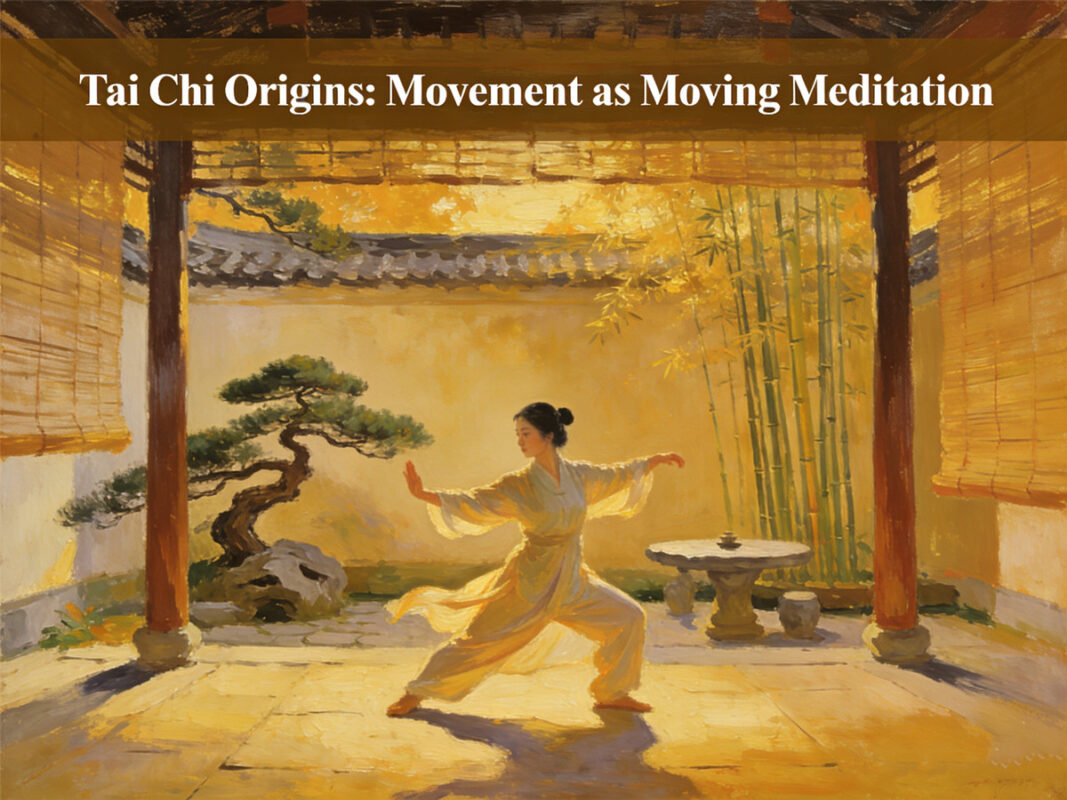
Tai Chi Origins: Movement as Moving Meditation
Mar
In a world often defined by frantic pace and fragmented attention, the search for practices that cultivate inner peace, physical vitality, and mental clarity remains a profound human pursuit. Among the treasures of ancient Chinese wisdom, Tai Chi Chuan (Taijiquan) stands out not merely as a martial art or gentle exercise, but as a sophisticated system of moving meditation. Its origins, deeply rooted in philosophy, martial necessity, and spiritual cultivation, reveal a practice designed to harmonize the individual with the fundamental principles of existence. Far from static contemplation, Tai Chi transforms the entire body into a vessel for mindful awareness, where every deliberate, flowing gesture becomes an expression of inner stillness and a conduit for cultivating Qi, the vital life force. Understanding its genesis illuminates why this graceful dance remains a powerful tool for holistic well-being centuries after its inception.
I. Beyond Martial Roots: The Emergence of a Meditative Practice
The origins of Tai Chi Chuan are often traced to the 17th century in Chenjiagou (Chen Village), Wenxian County, Henan Province, China. While popular folklore sometimes links it to the semi-mythical Daoist sage Zhang Sanfeng, historical consensus points to Chen Wangting (1580–1660), a Ming dynasty military commander, as the pivotal figure in its codification. Following the fall of the Ming dynasty, Chen retired to his village, synthesizing his extensive martial knowledge with principles derived from classical Chinese philosophy and health cultivation techniques.
- Martial Synthesis: Chen Wangting integrated elements from various existing martial arts systems, notably drawing from General Qi Jiguang’s influential military training manual, the Jixiao Xinshu (New Treatise on Military Efficiency). This provided the foundation for the combative techniques embedded within Tai Chi’s soft, yielding movements. The core innovation, however, lay in the application of profound internal principles.
- Philosophical Infusion: Crucially, Chen infused these martial movements with the core tenets of Daoism, particularly the concept of Yin and Yang – the complementary, interdependent forces of the universe. He also incorporated theories from Traditional Chinese Medicine (TCM) regarding Qi flow and meridian pathways. This integration shifted the emphasis from purely external power and aggression to internal strength, sensitivity, and the cultivation of energy.
- The Birth of Internal Art: This synthesis marked the genesis of what would be recognized as an internal martial art (Neijiaquan), distinct from the more externally forceful Waijiaquan styles. The focus moved towards developing internal power (Jing) through relaxation, mindful movement, and Qi cultivation, rather than relying solely on muscular tension. This internal focus inherently contained the seeds of its meditative dimension, as mindful awareness of the body and energy became paramount to its practice.
Thus, Tai Chi emerged not just as a fighting method, but as a holistic discipline where physical movement served as a vehicle for deeper internal awareness and energetic cultivation.
II. Philosophical Underpinnings: Daoism, Qi, and Harmony
The essence of Tai Chi as moving meditation cannot be understood without delving into the profound philosophical bedrock upon which it was constructed. Its movements are not arbitrary but are physical manifestations of ancient cosmological and spiritual concepts.
- The Dao and Wu Wei: Central to Tai Chi is the Daoist principle of the Dao, the indefinable source and pattern of the universe. Practitioners seek to embody the Daoist ideal of Wu Wei – often translated as “effortless action” or “non-forcing action.” In Tai Chi, this manifests as movements performed with relaxed power, yielding appropriately rather than opposing force directly, and allowing actions to arise naturally from a centered state. This requires profound relaxation and attentive awareness, hallmarks of meditative practice.
- Yin-Yang Dynamic: The interplay of Yin (receptive, yielding, soft, dark, feminine) and Yang (active, expansive, firm, light, masculine) is the dynamic engine of Tai Chi. Every posture and transition embodies this duality: expansion contains the seed of contraction, upward movement connects to a rooted base, a yielding gesture prepares for issuing force. Maintaining perfect balance and seamless transition between these opposites requires constant, focused attention, drawing the mind into a state of present-moment awareness akin to seated meditation.
- Qi Cultivation: The cultivation and harmonious flow of Qi is fundamental. Tai Chi movements are designed to stimulate, gather, and circulate Qi throughout the body via the meridian system. Deep, coordinated breathing synchronizes with movement, enhancing Qi flow. The mindful focus required to sense and guide Qi transforms the physical practice into a deeply internal, meditative experience. The practitioner becomes acutely aware of subtle energies and sensations within.
- Connection to the Wuji: The foundational starting posture of Tai Chi is often referred to as Wuji, representing the undifferentiated, infinite potential state before the emergence of Yin and Yang. Standing in Wuji requires quieting the mind, centering the body, and connecting to stillness – a meditative state in itself, from which all movement gracefully unfolds.
These principles ensure that Tai Chi is never merely exercise; it is a moving contemplation of the universe’s fundamental laws.
III. The Embodiment of Meditation: Core Principles in Motion
How does Tai Chi translate philosophical abstraction into tangible, moving meditation? It achieves this through specific principles embedded within its practice methodology, demanding a unique quality of attention.
- Slowness and Mindfulness: Unlike most physical activities, Tai Chi is practiced deliberately slowly. This slowness is not lethargy but a necessity. It allows the practitioner to maintain continuous awareness of every part of the body throughout the movement – the alignment of the spine, the weight distribution, the engagement of muscles, the flow of breath, and the subtle sensations of Qi. This constant, detailed internal observation anchors the mind in the present, preventing distraction, a core objective of meditation.
- Relaxation within Structure: A defining characteristic is Song – profound relaxation. This is not collapse, but relaxation within a correctly aligned structure. Releasing unnecessary tension allows Qi to flow unimpeded. Maintaining this relaxed structure while moving requires focused intention and kinesthetic awareness, drawing consciousness deeply into the body. The effort lies in letting go of tension, a mental as much as a physical act.
- Intentional Movement (Yi Leads Qi): In Tai Chi, movement is guided by Yi – the mind’s intention. The body follows where the mind leads. This is often summarized as “Yi leads Qi, Qi leads the body.” The practitioner develops the ability to focus their intention precisely, directing energy and movement with mindfulness. This focused intention is the very essence of meditative concentration applied dynamically.
- Coordination and Flow: The ultimate aim is achieving seamless coordination – the integration of mind, body, breath, and spirit into a single, flowing expression. Movements are continuous, circular, and interconnected, without awkward pauses or jerks. Maintaining this flow requires unwavering attention and a quiet mind, fostering a state akin to a moving trance or dynamic stillness.
Through these embodied principles, the practitioner cultivates a unique state of active tranquility, where the body moves with grace while the mind rests in heightened awareness.
IV. The Evolution of Styles: From Chen to Contemporary Practice
While the Chen family style is the acknowledged root, Tai Chi did not remain static. Over centuries, different masters interpreted the core principles, leading to the development of distinct major styles, each emphasizing particular aspects but all retaining the essence of moving meditation.
- Chen Style: The original form, characterized by its dynamic contrast between slow, flowing movements (Chan Su Jin – silk reeling energy) and sudden explosive bursts of power (Fa Jin). It retains pronounced martial applications and lower stances, demanding significant physical and energetic focus. Its complexity offers a deep well for meditative absorption.
- Yang Style: Developed by Yang Luchan (1799–1872), who learned from the Chen family. Yang style simplified and emphasized the slow, even, expansive, and graceful aspects, making it more accessible to a wider audience while preserving internal principles. Its smooth, continuous flow is particularly conducive to meditative practice and is the most widely practiced style globally today.
- Wu Style: Originating with Wu Quanyou (1834–1902), a student of Yang Luchan and his son Yang Banhou. Wu style features compact, subtle movements, a higher stance, and a pronounced forward-leaning posture. It emphasizes sensitivity (Ting Jin) and neutralizing incoming force with exceptional precision, requiring acute internal awareness.
- Sun Style: Created by Sun Lutang (1861–1933), a master of Xingyiquan and Baguazhang before studying Wu style Tai Chi. Sun style incorporates unique agile footwork, resembling a dance, with a noticeable rise and fall in stance. It integrates elements from Sun’s other internal arts, emphasizing Qi cultivation and health benefits, offering a unique meditative rhythm.
- Hao Style: Less widespread, developed by Wu Yuxiang (1812–1880), another Yang family student. Hao style is characterized by very small, precise movements performed from an upright posture, placing extreme emphasis on internal control and mental focus, making it a highly internalized form of moving meditation.
Despite stylistic variations, all lineages share the foundational goal of unifying mind, body, and Qi through mindful, intentional movement.
V. The Resonant Benefits: Cultivating Wholeness Through Movement
The practice of Tai Chi as moving meditation yields a rich tapestry of benefits that permeate physical health, mental acuity, emotional balance, and energetic vitality. Modern research increasingly validates what practitioners have experienced for generations.
- Physical Well-being: The gentle, weight-bearing movements enhance muscle strength, particularly in the legs and core, improve flexibility and range of motion, and promote better balance and coordination, significantly reducing fall risk, especially in older adults. Improved proprioception (body awareness in space) is a direct result of mindful movement. Enhanced cardiovascular health and support for joint health are also documented benefits.
- Stress Reduction and Mental Clarity: The requirement for focused attention on movement and breath induces a relaxation response, effectively counteracting stress hormones. Regular practice is strongly associated with reduced symptoms of anxiety and depression, improved sleep quality, and enhanced overall mood. The meditative aspect cultivates mindfulness, improving concentration, cognitive function, and fostering a sense of mental calm and clarity amidst daily challenges.
- Energetic Cultivation: At its core, Tai Chi is a practice for enhancing Qi flow. Practitioners often report increased vitality, reduced fatigue, and a greater sense of overall resilience. The mindful movement and deep breathing stimulate the body’s subtle energy system, potentially supporting the body’s innate self-healing capacities according to TCM principles. The feeling of being more grounded and energetically integrated is a common experience.
- Holistic Integration: Ultimately, Tai Chi fosters a profound sense of mind-body integration. The practitioner becomes more aware of internal states, sensations, and thought patterns. This heightened self-awareness can lead to greater emotional regulation, a deeper sense of inner peace, and a feeling of being more fully present and connected within oneself and to the surrounding environment.
These benefits are synergistic, each reinforcing the others, creating a positive feedback loop of enhanced well-being.
VI. Integrating the Moving Silence: Making Tai Chi a Living Practice
Embracing Tai Chi as a lifelong journey of moving meditation requires integrating its principles into the rhythm of daily life. It is an art that deepens with consistent, mindful engagement.
- Establishing Consistent Practice: Begin with short, regular sessions. Even 15-20 minutes daily yields significant benefits over time. Consistency is paramount; sporadic long sessions are less effective than daily engagement. Find a qualified instructor to learn the fundamentals correctly – posture, alignment, and movement principles are crucial for both safety and depth of experience. Resources abound, from local community classes to online platforms.
- Cultivating Mindful Presence: Approach each practice session not as exercise, but as meditation in motion. Focus on the quality of attention: feel the feet connecting with the ground (rooting), observe the breath synchronizing with movement, notice the subtle shifts of weight and energy. When the mind wanders (as it inevitably will), gently bring it back to the sensations of the body and breath. Patience and self-compassion are essential companions.
- Extending Awareness Beyond the Form: The true integration happens when the mindful awareness cultivated during formal practice begins to seep into everyday activities. Notice posture while sitting or standing, breathe consciously during moments of stress, move with intention and grace during simple tasks. Tai Chi principles of balance, yielding, and centeredness can inform interactions and responses to life’s challenges.
- Creating a Conducive Atmosphere: While Tai Chi can be practiced anywhere, cultivating a supportive environment enhances the experience. A clean, uncluttered space allows energy (Qi) to flow freely. Some practitioners find that incorporating elements symbolizing tranquility or natural harmony – perhaps a simple, intentionally placed Feng Shui accessory like a smooth river stone or an object representing balance – can subtly support the meditative state. Similarly, the mindful aesthetic of Dao crafts – objects created with attention to natural materials and harmonious form – can serve as gentle reminders of the principles embodied in Tai Chi practice. Explore pieces that resonate with your journey towards inner harmony at daocrafts.com.
Tai Chi, born from martial necessity and philosophical depth, offers a timeless path to wellness through the profound simplicity of mindful movement. It is a testament to the human capacity to transform action into contemplation, finding stillness within motion, and cultivating a deep, resonant harmony that echoes through body, mind, and spirit. Its origins remind us that true power and peace often arise not from force, but from the quiet, attentive flow of presence.