
Interesting Dao
Zhuangzi’s Inner Chapters: Daoist Parables Unlocked
Nov
The Inner Chapters of Zhuangzi remain one of the most elusive yet profound bodies of philosophical writing in world literature, and although their surface-level playfulness can mislead some readers into thinking that Zhuangzi’s project is whimsical or deliberately opaque, a deeper reading reveals a carefully structured exploration of freedom, spontaneity, perspective, and the art of living without being trapped by the illusions engineered by society, culture, language, and even one’s own mind. These chapters continue to captivate modern readers because they present ideas not through rigid doctrine but through stories, metaphors, parables, and rhetorical inversions that encourage the reader to unlearn rather than acquire, to shed conceptual baggage rather than accumulate new systems of thought.
In what follows, we explore several key dimensions of the Inner Chapters, examining how their imagery and parables open pathways into a worldview where flexibility is a virtue, boundaries dissolve under scrutiny, and the line between the useful and the useless is constantly redrawn.
1. Understanding the Inner Chapters: Structure and Philosophical Intent
The Inner Chapters—consisting of the first seven chapters of the Zhuangzi—represent the text’s philosophical core, not only because they are widely regarded as the work of Zhuangzi himself, but also because they outline the essential themes that would later influence Chinese aesthetics, religion, art, and contemplative practice. Rather than provide a systematic doctrine, Zhuangzi constructs a series of free-flowing meditations, where ideas emerge not from definitions but from metaphorical collisions between what seems ordinary and what appears extraordinary.
Zhuangzi’s intention is not to instruct the reader on what to believe; instead, he invites the reader to experience a shift in vantage point, a broadening of perception that dissolves the fixation on fixed viewpoints. This structure—playful on the surface yet razor-sharp beneath—sets the tone for the entire Daoist tradition that follows.
The Non-Systematic System
Unlike the rigid structures of certain philosophical schools, the Inner Chapters rely on indirectness. They encourage readers to navigate paradox naturally, to recognize that life cannot be captured by static categories, and to embrace a fluidity of mind that allows genuine understanding to emerge without force.
2. The Parable of the Giant Peng Bird: Freedom Through Perspective
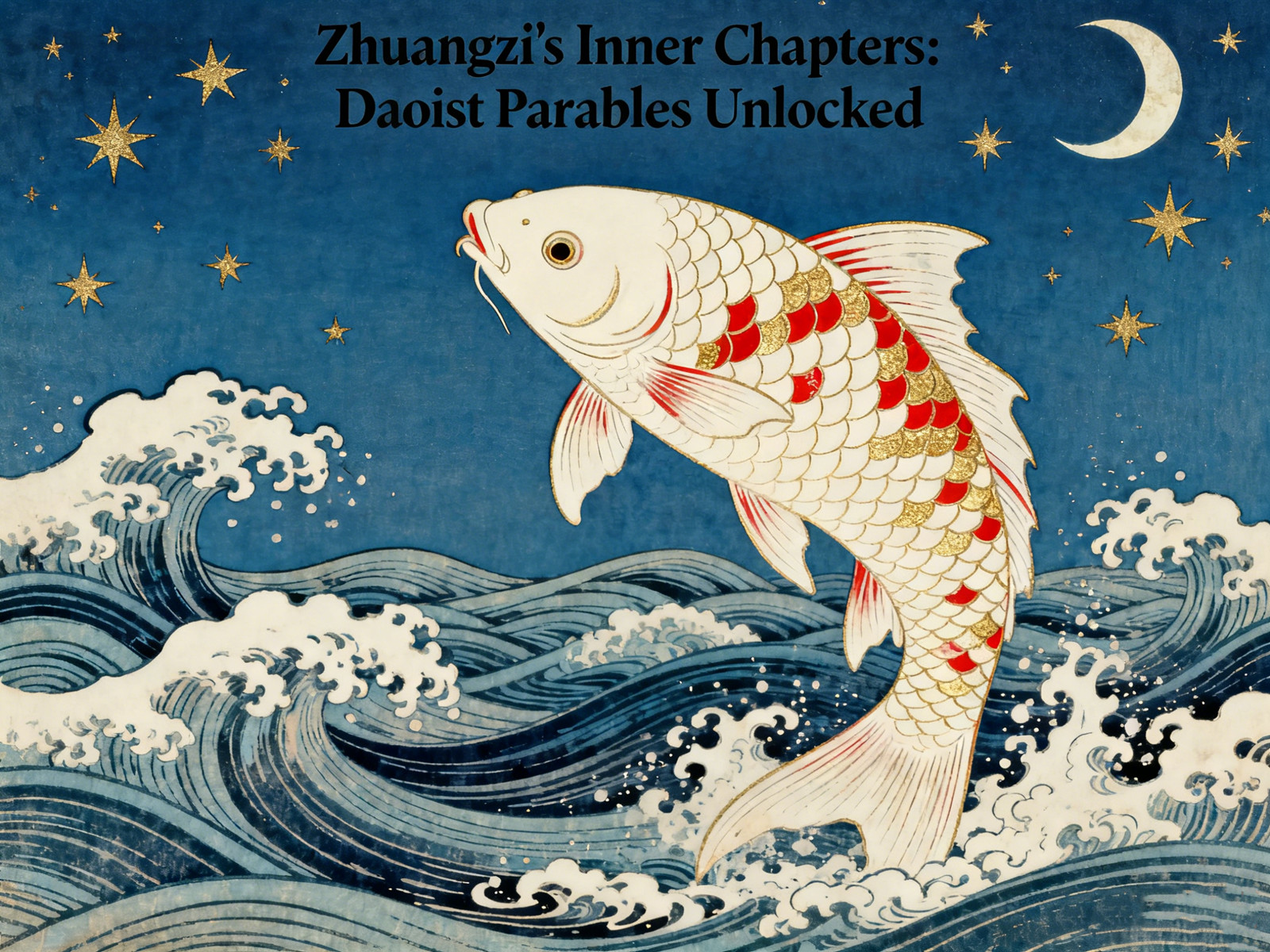
One of the most famous parables in the Inner Chapters is the story of the gigantic peng bird, whose wings, when spread, cover the sky itself, and whose journey across the heavens occupies tens of thousands of miles as it ascends to unimaginable heights. The story opens the text with a tone that is both mythical and analytical, asking the reader to consider the scale at which meaning is created.
The tiny cicada and the small dove laugh at the peng, unable to comprehend its journey, because their world is measured in a few steps and brief flights between low branches. This contrast is not meant to mock either creature but to illuminate the relativity of perspective.
What the Peng Represents
Zhuangzi uses the peng as a metaphor for boundless vision—a mind that can soar beyond social conventions, rigid categories, and the constraints of habitual thinking. The cicada and the dove represent limited perspective, bound by narrow experience and confident in their own smallness without recognizing its limitations.
However, Zhuangzi does not privilege the large over the small; he simply reveals that each perspective is relative, and that understanding arises when one stops clinging to one’s particular vantage point as absolute.
3. The Useless Tree: A Challenge to Conventional Value
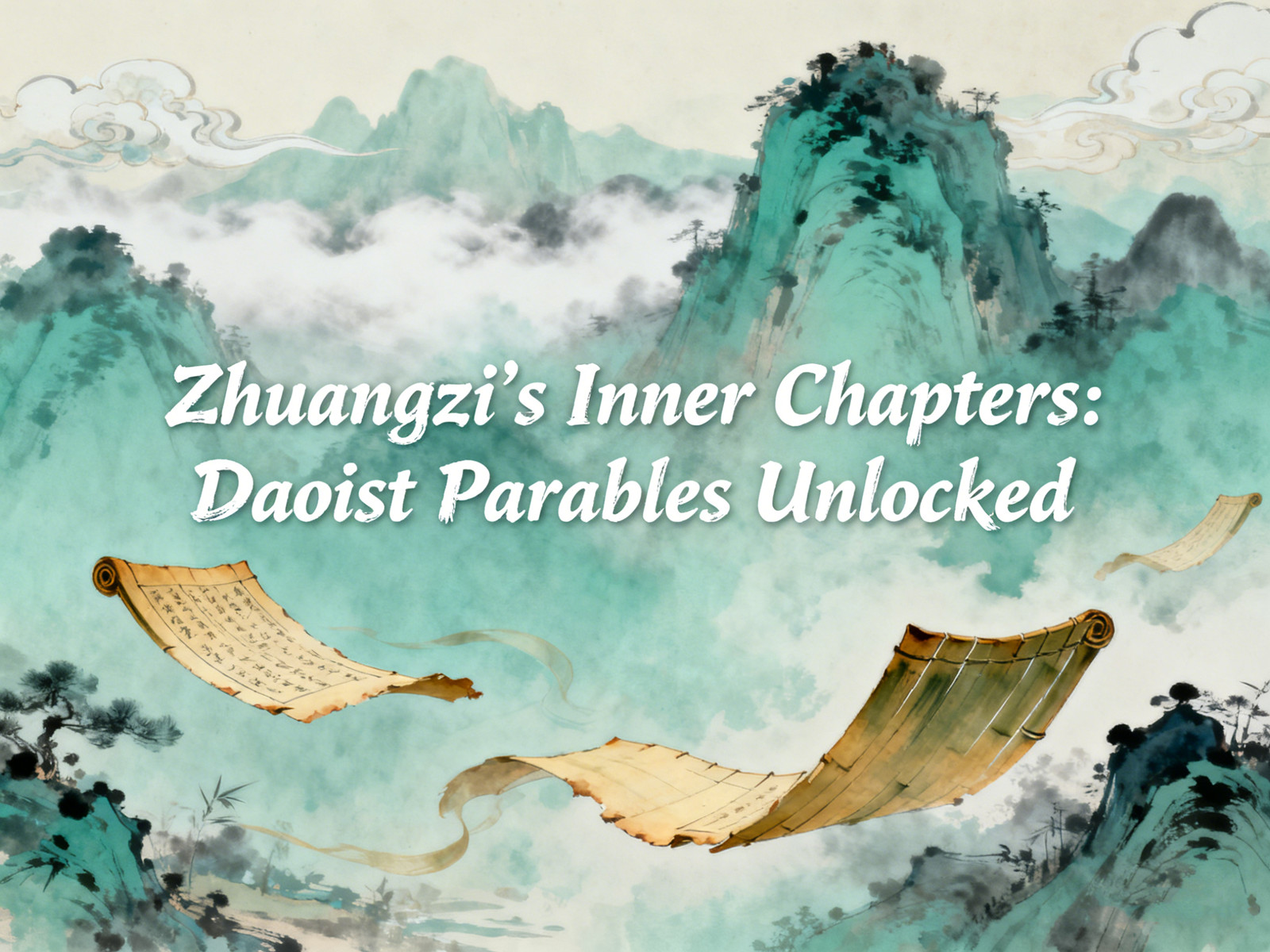
Another beloved parable is that of the “useless tree,” a gnarled trunk whose twisted form renders it unfit for lumber or carpentry, yet this very uselessness allows it to live out its years in peace, untouched by axes and saws.
Zhuangzi asks a provocative question: is usefulness truly a virtue when it leads to destruction, exploitation, or exhaustion? And conversely, is uselessness a flaw when it allows for longevity, safety, and quiet flourishing?
The Paradox of Use and Uselessness
The story teaches the reader to question inherited value systems that prioritize productivity, efficiency, and measurable output above well-being or natural integrity. Zhuangzi points out that what society often regards as useful may lead individuals to compromise themselves in pursuit of external validation or professional identity, whereas what appears useless may offer a sanctuary from the grinding demands of utility.
This redefinition resonates deeply in modern life, where many individuals feel trapped by expectations that force them into predefined roles.
4. The Butterfly Dream: Identity and the Limits of Knowing
Perhaps the most iconic of all Zhuangzi’s passages is the Butterfly Dream, a deceptively simple story in which Zhuangzi dreams he is a carefree butterfly, only to awaken and wonder whether he is now a man who dreamed of being a butterfly or a butterfly dreaming of being a man.
The dream challenges the stability of identity, calling into question whether the categories we use to define ourselves are any more real than the images of a dream.
The Erosion of Binary Distinctions
At its core, the Butterfly Dream shows how fluid the boundaries between waking and dreaming, self and other, or reality and illusion can be. Zhuangzi refuses to draw a sharp line between states of being, and instead encourages the reader to accept ambiguity as a natural feature of existence.
In doing so, he pushes us to reconsider our confidence in what we think we know, exposing the fragility of assumptions about consciousness and selfhood.
5. Skill Stories and the Art of Effortless Action
Zhuangzi’s Inner Chapters contain vivid stories of artisans whose mastery appears effortless, such as Butcher Ding, whose knife never needs sharpening because he cuts through the spaces between the joints rather than forcing the blade through bone. This story illustrates the Daoist concept of wu wei, often translated as “effortless action,” although a more nuanced reading suggests action that flows in complete harmony with natural patterns.
Learning to Move with the Grain of Reality
Butcher Ding is not supernatural; rather, his mastery reflects a deep attunement to the structure of what he works with. His actions are guided by responsiveness rather than forcing outcomes, a principle that resonates with modern ideas of flow state psychology, where skill and awareness align to create seamless action.
For Zhuangzi, mastery arises not from rigid discipline but from flexible, intuitive engagement with the world, a theme that permeates many other parables in the Inner Chapters.
6. Relativity, Language, and the Problem of Fixed Distinctions
One of Zhuangzi’s core critiques revolves around language itself, which he perceives as inherently limited because words freeze fluid processes into static categories. When people rely on language to describe reality, they begin to treat linguistic distinctions as permanent truths, unable to perceive the dynamic, shifting nature of the world.
This linguistic critique runs throughout the Inner Chapters, as Zhuangzi repeatedly shows how conflict arises when people cling to rigid definitions rather than recognizing the relative nature of concepts like good and bad, right and wrong, big and small, useful and useless.
Zhuangzi’s Relativism as Philosophical Liberation
Zhuangzi does not promote relativism in the chaotic sense; rather, he demonstrates that freedom emerges when one releases the compulsion to impose order where none naturally exists. When distinctions are treated as provisional rather than absolute, individuals can move more freely through the complexities of life, adapting to changing circumstances without anxiety or rigidity.
7. Why Zhuangzi Still Matters: Modern Interpretations and Cultural Resonance
The Inner Chapters remain profoundly relevant to contemporary readers because they offer strategies for navigating a world where pressure, identity, and expectation often feel overwhelming. Zhuangzi’s emphasis on fluidity, perspective, and inner freedom resonates with those seeking alternatives to rigid belief systems or high-pressure cultural norms.
Many modern practitioners draw upon Zhuangzi’s insights not as commandments but as invitations to loosen the grip of certainty, slow down the frantic pace of modernity, and rediscover a more spacious, open-ended relationship with life.
The Artistic and Cultural Revival
The parables inspire artists, writers, spiritual seekers, and philosophers, who see in Zhuangzi’s playful style a refuge from the burdens of linear reasoning. Even contemporary makers of Daoist-inspired objects, including creators at daocrafts.com, draw on Zhuangzi’s imaginative imagery to shape designs that acknowledge the subtle interplay between form, emptiness, and meaning.
Living Zhuangzi’s Spirit Today
Zhuangzi’s teachings encourage individuals to embrace uncertainty with courage, to recognize the limits of personal perspective, and to cultivate a quiet resilience rooted not in control but in adaptability. These lessons, transmitted through lively stories and paradoxical puzzles, continue to illuminate pathways toward freedom in a world that often equates productivity with worth, consistency with integrity, and conformity with wisdom.
To read the Inner Chapters is to embark on a journey toward a mind that can, like the peng bird, soar beyond its own limitations, discovering vast new landscapes of thought and possibility.