
Dao Story, Interesting Dao
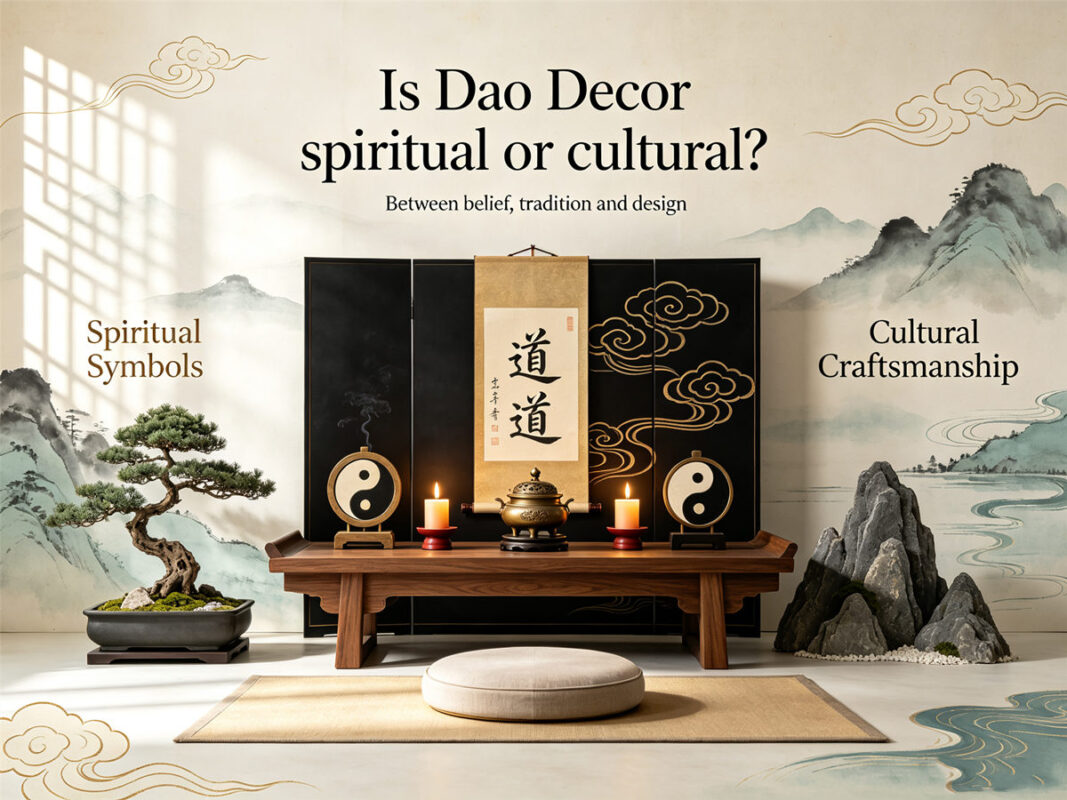
Is Dao Decor spiritual or cultural?
Aug
When people first encounter Dao-inspired decorative objects, one of the most common questions is whether they should be understood as spiritual objects, cultural artworks, or simply decorative products. The answer is not as straightforward as it may seem because Daoist traditions themselves contain philosophical, religious, artistic, and cultural dimensions, while modern products inspired by those traditions can serve very different purposes depending on how they are designed and how they are used.
A carved Bagua plaque hanging on a wall, a Taiji ornament placed on a shelf, a landscape painting inspired by traditional Chinese philosophy, or a handmade incense holder may all be described as Dao-inspired decor, yet these objects do not necessarily have the same religious function. Some may have genuine ritual or devotional associations, while others simply borrow traditional visual language to create a calm, balanced, and culturally meaningful atmosphere.
Understanding this distinction is important for both consumers and sellers. It allows people to appreciate traditional symbolism without automatically treating every decorative object as a religious artifact, while also avoiding the opposite mistake of reducing meaningful cultural traditions to nothing more than fashionable decoration.
1. Why Dao Decor Can Be Both Spiritual and Cultural
The first point to understand is that Dao decor exists across a spectrum rather than fitting into a single category. An object can have cultural significance without being intended for religious practice, and an object can have spiritual associations while also possessing considerable artistic and historical value.
Daoist traditions developed over many centuries and influenced Chinese philosophy, religion, literature, painting, architecture, medicine, martial arts, landscape aesthetics, and everyday ideas about harmony and nature. Consequently, visual elements associated with Daoism can appear in contexts that are explicitly religious as well as in ordinary cultural and artistic settings.
For example, the Taiji symbol is widely recognized today, but seeing it on a modern wall decoration does not necessarily mean that the owner is practicing Daoism. It may simply represent balance, harmony, complementary forces, or an appreciation of traditional Chinese philosophy.
Likewise, a mountain-and-water landscape may evoke philosophical ideas about humanity’s relationship with nature without functioning as a religious object.
The Context Determines Much of the Meaning
The same visual symbol can have different meanings depending on its context, the intention of its maker, and the way it is used.
A talisman created for a specific religious purpose should not be treated in exactly the same way as a contemporary decorative print featuring a similar pattern. A ritual object made for a temple or religious practitioner has a different function from a mass-produced ornament designed for an international home-decor market.
This is why it is useful to ask what the object was made for, rather than deciding what it is based only on its appearance.
2. Understanding the Spiritual Dimension of Dao-Inspired Objects
There is a genuine spiritual dimension to many objects associated with Daoist traditions. Religious Daoism includes rituals, sacred spaces, deities, scriptures, talismans, ceremonies, meditation practices, and objects that have specific religious functions.
Certain symbols and objects therefore cannot be accurately understood simply as decoration when they were originally created within a religious context.
However, this does not mean that every modern object displaying a traditional Daoist symbol possesses a religious function.
Religious Objects and Decorative Objects Are Different
A religious object may be created according to particular traditions, used within a specific ritual context, or associated with a particular temple, lineage, or practice. Its meaning may depend on knowledge and procedures that are not visible from its physical appearance.
A decorative object, on the other hand, may use the same visual language primarily for artistic or cultural reasons.
This distinction becomes particularly important in commercial descriptions. A seller should avoid implying that an ordinary decorative item has been spiritually empowered, ritually consecrated, or historically used in religious practice unless there is credible evidence supporting such a claim.
Responsible descriptions can explain a symbol’s traditional associations while clearly identifying the product’s modern purpose.
3. The Cultural Side of Dao Decor
The cultural dimension of Dao-inspired decoration is perhaps easier to recognize because traditional Chinese aesthetics have had a substantial influence on architecture, furniture, painting, ceramics, textiles, gardens, and interior design.
Many of these forms emphasize simplicity, natural materials, asymmetry, balance, empty space, and harmony with the surrounding environment. These principles can be incorporated into modern interiors without requiring the homeowner to adopt a particular religious belief.
A simple wooden carving, a monochromatic landscape painting, a ceramic incense holder, or a naturally textured wall ornament may create an atmosphere associated with traditional Chinese aesthetics while functioning entirely as an art or interior-design element.
This is particularly relevant today because contemporary consumers increasingly seek objects with a story behind them. Instead of choosing purely decorative products with no cultural identity, they may prefer objects that communicate something about history, craftsmanship, philosophy, or nature.
Cultural Appreciation Does Not Require Religious Practice
A person can appreciate Daoist philosophy, traditional Chinese art, or Dao-inspired design without identifying as Daoist or participating in religious practice.
Someone might enjoy the concept of living in greater harmony with nature, appreciate traditional landscape painting, or find Taiji imagery visually compelling while approaching these ideas from an artistic or philosophical perspective.
This distinction makes Dao-inspired decor accessible to a much broader audience while still allowing traditional cultural elements to retain their significance.
4. Common Symbols Found in Dao-Inspired Decor
Understanding common symbols can help consumers interpret what they see without automatically assigning supernatural meanings to them.
Taiji and Yin-Yang
The Taiji symbol, commonly represented through the familiar black-and-white circular design, is associated with the complementary relationship between yin and yang. In modern design, it is often used to express balance, harmony, and dynamic interaction.
Its presence in a wall ornament or piece of artwork does not by itself prove that the object is religious.
Bagua and the Eight Trigrams
The Bagua consists of eight trigrams associated with traditional Chinese cosmological thought and has important connections with classical Chinese philosophy and Daoist traditions.
Because Bagua designs are visually distinctive, they appear frequently in jewelry, wall decorations, architectural elements, and modern interior products. Again, the purpose of a particular object depends on its context.
A contemporary Bagua-inspired decoration may simply be an artistic interpretation, whereas a traditional religious object may have a more specific function.
Nature-Based Imagery
Mountains, water, clouds, trees, cranes, and other natural motifs are also common in Chinese art and Dao-inspired design. Their significance often extends beyond religious symbolism and can represent broader ideas about longevity, tranquility, resilience, harmony, and the relationship between humans and nature.
This is one reason natural imagery works so well in modern interior design.
5. How Dao Decor Fits Into Modern Interior Design
One reason Dao-inspired decoration has become attractive to contemporary homeowners is that its visual language often complements modern minimalist interiors.
A room does not need to be filled with traditional objects to communicate a sense of cultural inspiration. One carefully selected wooden carving, ceramic piece, landscape artwork, or symbolic wall ornament can provide a focal point while leaving plenty of visual space around it.
Natural materials are especially effective because wood, stone, bamboo, ceramic, cotton, and linen can create warmth without overwhelming the room.
Minimalism and Traditional Aesthetics
Modern minimalist design and traditional Chinese aesthetics can work surprisingly well together because both can place emphasis on proportion, negative space, restrained decoration, and natural materials.
For example, a simple wooden Taiji ornament can be placed against a neutral wall, allowing the shape and material to become the primary visual feature. Similarly, a traditional-inspired landscape painting can create depth in an otherwise minimalist room without introducing excessive color.
The objective is not to recreate a historical Chinese interior but to reinterpret traditional ideas in a contemporary environment.
6. How to Choose Authentic and Respectful Dao Decor
When purchasing Dao-inspired decorative objects, consumers should pay attention to more than appearance. A professionally presented product should explain what the object is, what materials were used, where it was made, and whether it is traditional, historically inspired, or entirely contemporary.
Claims should also be examined carefully.
A product description that says a particular ornament is “inspired by traditional Bagua symbolism” is very different from claiming that the object is an ancient religious artifact or possesses guaranteed supernatural powers.
Look for Craftsmanship and Transparency
High-quality craftsmanship is often more meaningful than exaggerated spiritual claims. Examine the material, carving, engraving, surface finishing, construction, and overall proportions.
If an item is handmade, the seller should ideally provide information about the artisan or production process. If an object is claimed to be antique, documentation and provenance become much more important.
Consumers should also be cautious when a seller uses fear-based or overly sensational claims to encourage a purchase. Traditional Daoist culture is complex, and reducing it to promises of instant wealth or guaranteed protection can create a misleading picture of the tradition.
7. Appreciating the Tradition Without Oversimplifying It
The question of whether Dao decor is spiritual or cultural ultimately has no single answer because the two dimensions can overlap. Some objects have genuine religious significance, some are primarily cultural or artistic, and many contemporary products exist somewhere between these categories.
The most useful approach is therefore to look at origin, purpose, context, symbolism, craftsmanship, and use. Rather than assuming that every Bagua ornament is a spiritual tool or that every Dao-inspired object is merely decorative, consumers can take the time to understand what they are actually looking at.
This approach also creates a healthier relationship between commercial design and cultural heritage. Traditional symbols can be introduced to new audiences without being stripped entirely of their history, while modern products can be enjoyed without making unsupported religious claims.
For people building a personal collection, Dao Accessories can provide a wearable extension of the same aesthetic, with pendants, bracelets, charms, and other objects incorporating traditional-inspired symbols into everyday life while remaining clearly distinct from formal religious artifacts.
For interior spaces, Dao decor can bring together natural materials, traditional motifs, calligraphy-inspired artwork, landscape imagery, symbolic ornaments, and handcrafted objects, allowing homeowners to create an atmosphere of simplicity and balance without needing to turn their living space into a religious environment.
For those who are particularly interested in the craftsmanship behind these objects, Dao Crafts offer another perspective, shifting attention from symbolism alone toward carving, woodworking, ceramics, metalwork, textiles, and other traditional-inspired techniques. Exploring collections and artisan-made pieces through platforms such as daocrafts.com can therefore be a useful way to appreciate the relationship between cultural heritage, contemporary design, and skilled craftsmanship, especially when product descriptions provide clear information about materials, origins, techniques, and intended use.