Dao Story, Interesting Dao
What does Dao Charm symbolize?
Aug
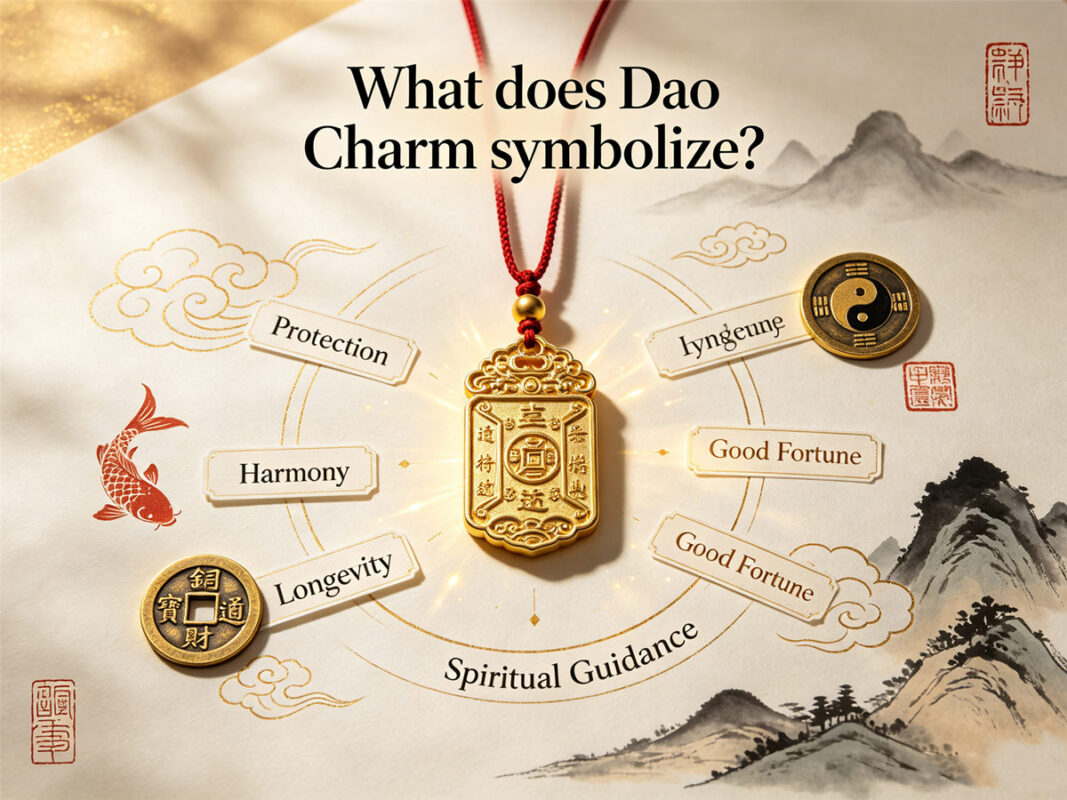
A Dao charm is more than a small decorative object worn around the neck, carried in a pocket, attached to a bag, or displayed in a personal space. For many people, its appeal comes from the combination of traditional Chinese symbolism, philosophical ideas, artistic design, and the personal meaning attached to the object by its owner. Depending on its shape, inscription, material, and cultural background, a Dao-inspired charm may represent harmony, balance, protection, wisdom, prosperity, longevity, or a closer relationship with nature.
At the same time, it is important to understand that there is no single universal meaning assigned to every Dao charm. A Taiji pendant, a Bagua ornament, a charm featuring a traditional Chinese character, and a natural-material carving may all be described as Dao-inspired, yet their symbolism and historical context can be quite different. Modern products may also interpret traditional ideas in new ways, making them accessible to people who appreciate the aesthetic without necessarily practicing Daoism.
For this reason, understanding what a Dao charm symbolizes requires looking beyond its appearance. The symbol itself, the tradition from which it comes, the purpose for which the object was created, and the intentions of the person giving or receiving it all contribute to its meaning.
1. The Basic Meaning of a Dao Charm
The word “charm” often suggests an object believed to bring good fortune or protection, but the concept can be broader when discussing Dao-inspired objects. A charm may function as a personal reminder of a particular value or aspiration rather than as a guarantee of a supernatural result.
In traditional Chinese culture, objects with auspicious meanings have long been exchanged or displayed as expressions of good wishes. A person may give an ornament to a friend wishing them peace, wear a symbolic pendant as a reminder of balance, or place a decorative object in the home because its imagery represents harmony and prosperity.
A modern Dao charm can therefore be understood on several levels at once. It may have an aesthetic function, a cultural meaning, a personal emotional significance, and, in some contexts, a religious association.
The most important distinction is that symbolic meaning should not automatically be interpreted as a promise of supernatural power. A charm can represent protection without providing a scientifically measurable guarantee of protection, just as a wedding ring can represent love without physically creating the relationship it symbolizes.
Symbolism Depends on Context
The same motif can mean different things in different settings. A Bagua symbol displayed as part of contemporary interior design may be primarily cultural or decorative, while a specific object used within a religious context may carry a more specialized meaning.
This is why responsible descriptions of Dao charms should explain the background of a symbol instead of assigning exaggerated claims to every object.
2. Taiji and Yin-Yang: The Symbol of Balance
One of the most recognizable motifs associated with Dao-inspired design is the Taiji symbol, commonly represented through the familiar circular black-and-white form often called yin-yang.
The imagery is widely associated with the relationship between yin and yang, traditionally understood as complementary aspects or forces rather than simple opposites. Darkness and light, stillness and movement, softness and strength, and other paired qualities can be understood through this framework.
The significance of the symbol is therefore closely connected with balance and dynamic relationships.
A Taiji charm may appeal to someone who wants a personal reminder to seek greater balance in daily life. Instead of representing perfection or a completely static state, the symbol can suggest that different qualities continuously interact and transform.
Why Taiji Charms Are So Popular
The simplicity of the circular design makes Taiji particularly suitable for jewelry and small decorative objects. It can be engraved into metal, carved into wood or stone, incorporated into ceramic pieces, or used as the central motif of a pendant.
Its visual simplicity also allows it to work with both traditional and contemporary clothing, which makes a Taiji-inspired charm easy to incorporate into modern personal style.
3. Bagua Charms and Their Symbolic Meaning
Another important design found in Dao-inspired charms is the Bagua, which consists of eight trigrams traditionally associated with classical Chinese cosmological thought and the Yijing or Book of Changes tradition.
The eight trigrams are represented through combinations of broken and unbroken lines, creating a visually distinctive circular arrangement when presented together.
Bagua imagery has a long cultural history and can appear in philosophical, religious, architectural, artistic, and decorative contexts. Consequently, a Bagua charm may be appreciated for its historical symbolism as well as its visual structure.
Balance, Change, and the Natural Order
The Bagua is often associated with concepts involving relationships, transformation, natural phenomena, and patterns of change. This makes it particularly interesting as a symbolic object because its meaning extends beyond the simple idea of “good luck.”
For a modern wearer, a Bagua charm may therefore represent an appreciation of traditional Chinese thought, a reminder of adaptability, or an interest in the relationship between human life and the natural world.
However, consumers should be cautious when sellers claim that every Bagua pendant automatically provides guaranteed protection, financial success, or other supernatural outcomes. Cultural symbolism and commercial promises are not the same thing.
4. Protection, Harmony, and Personal Well-Being
Protection is one of the meanings frequently associated with traditional charms, and this explains why Dao-inspired pendants are often purchased as gifts for family members, friends, or people beginning a new stage of life.
The idea of protection can be understood in several ways. In a religious context, certain objects may have specific ritual functions. In a cultural context, a charm may express the wish that someone remains safe and well. In a personal context, it may simply serve as a reminder to approach life with calmness and awareness.
This distinction is particularly important for modern consumers because a symbolic charm does not need to be treated as a supernatural object to have emotional value.
A parent might give a charm to a child before they leave home, for example, not because the parent believes the physical object can guarantee safety, but because the charm represents the parent’s continuing care and good wishes.
A Symbolic Reminder in Everyday Life
Small objects can become powerful reminders because people interact with them repeatedly. Seeing a pendant in the morning may remind someone to remain calm during a difficult day, while a charm placed on a desk may symbolize balance and patience.
In this sense, the meaning of a charm can become partly personal. Its significance is shaped not only by tradition but also by the story the owner attaches to it.
5. Prosperity, Good Fortune, and Positive Wishes
Many modern Dao-inspired charms are marketed around ideas such as prosperity, good fortune, success, and abundance. These concepts have deep roots in Chinese gift-giving culture, where objects, colors, words, animals, and patterns can be used to communicate auspicious wishes.
However, it is useful to distinguish between symbolizing good fortune and claiming to mechanically create good fortune.
A charm given to someone starting a business may symbolize a wish for success. A pendant given at a wedding may represent hopes for harmony and happiness. A decorative object placed in a new home may express wishes for peace and prosperity.
The emotional value comes largely from the intention behind the gift.
Why Fortune Charms Make Meaningful Gifts
A symbolic object can communicate something that an ordinary gift sometimes cannot. Instead of saying only “I bought this for you,” the giver can attach a particular message to the object: I hope you remain safe, I hope your new journey goes well, or I hope your life remains balanced and peaceful.
This makes Dao-inspired charms particularly suitable for birthdays, housewarmings, business openings, festivals, graduations, weddings, and other meaningful occasions.
6. Nature, Simplicity, and Harmony
Daoist thought has a strong association with nature, and this influence can be reflected in the materials and imagery used for traditional-inspired charms.
Mountains, water, clouds, trees, birds, stones, and other natural elements may appear in decorative designs. Even when these motifs are not directly religious, they can evoke broader ideas about living in harmony with the natural world.
Natural materials can reinforce this impression. Wood, stone, bamboo, ceramic, and metal each provide a different tactile experience, while handmade imperfections can give a charm a more individual character.
The Appeal of Natural Materials
A natural-material charm often feels different from mass-produced plastic decoration because it has visible texture and variation. Wood may show grain patterns, stone may contain natural inclusions, and handmade ceramic may have subtle differences in surface texture.
These characteristics can complement the philosophy of simplicity that many people associate with Dao-inspired aesthetics.
The objective is not necessarily to make the object look ancient. A contemporary charm can be completely new while still drawing inspiration from traditional materials, forms, and artistic principles.
7. Choosing a Dao Charm With Genuine Meaning
When selecting a Dao charm, buyers should first consider what they want the object to represent. If the primary purpose is balance, a Taiji-inspired design may be appropriate. If the recipient is interested in classical Chinese symbolism, a Bagua motif may be more suitable. For a gift, the meaning of the object should ideally correspond with the occasion and relationship between the giver and recipient.
Material and craftsmanship should also be considered carefully. A well-made charm should have clean edges, consistent engraving, secure attachment points, and a material description that is clear rather than vague.
Buyers should also be cautious about overly dramatic claims. Statements suggesting that a charm can guarantee wealth, eliminate misfortune, cure illness, or provide supernatural protection should not be treated as evidence of authenticity or quality.
A credible seller should instead explain the cultural background of the design and clearly distinguish traditional symbolism from modern interpretation.
For people who enjoy wearing symbolic pieces as part of their personal style, Dao Accessories provide an easy way to incorporate traditional-inspired motifs into everyday life, whether through pendants, bracelets, necklaces, key charms, or other small objects that combine cultural symbolism with contemporary design.
For those who want to bring the same aesthetic into their living environment, Dao decor can extend these ideas through wall ornaments, carved objects, calligraphy-inspired artwork, ceramic pieces, natural-material decorations, and other items designed to create a calm and balanced atmosphere without necessarily functioning as religious objects.
For collectors and people who are particularly interested in traditional craftsmanship, Dao Crafts offer an even deeper connection to the artistic side of these traditions, with handmade carving, woodworking, metalwork, ceramics, textiles, and other techniques providing a physical expression of cultural heritage. Exploring artisan-inspired collections through daocrafts.com can help buyers discover pieces where symbolism, materials, design, and craftsmanship come together, making a Dao charm meaningful not because it promises a magical result, but because it carries a story, expresses a thoughtful wish, and connects contemporary life with a rich tradition of Chinese philosophy and artistic expression.