
Interesting Dao
How to Identify Real Dao Accessories: A Practical Guide to Craft, Authenticity, and Detail
May
1. Understanding What “Real” Means in Dao Accessories
When people try to determine how to identify real Dao Accessories, the first challenge is often not physical inspection but understanding what “real” actually means in this context, because authenticity is not always defined by a single material, origin label, or manufacturing method. In many cases, Dao-inspired accessories exist on a spectrum that ranges from fully handcrafted traditional pieces to modern interpretations influenced by cultural design principles, and both can carry value depending on intention, craftsmanship, and honesty in presentation.
A genuine Dao accessory is typically characterized less by branding and more by coherence between design philosophy, material integrity, and construction quality. In other words, it should feel intentional rather than decorative in a superficial sense, with every detail contributing to a sense of balance, symbolism, or cultural continuity rather than random ornamentation. This is why identifying authenticity requires a more careful eye than simply checking price tags or marketing claims.
At the same time, the growing popularity of Dao-inspired design has led to a wide range of mass-produced items that imitate traditional aesthetics without respecting their underlying craftsmanship principles. These pieces are not necessarily “fake,” but they are often stylistically simplified versions that prioritize commercial appeal over cultural or artisanal depth.
Authenticity as craftsmanship, not just origin
A key point to understand is that real Dao accessories are often defined by how they are made rather than where they are made. Hand-finished detailing, balanced proportions, and thoughtful material selection tend to matter more than geographic labels alone. Even within modern production environments, skilled artisans can produce authentic-feeling pieces if traditional methods and design discipline are respected.
This means authenticity should be evaluated through observation and touch, not just certification or description.
2. Material Quality and Physical Indicators of Authentic Dao Accessories
One of the most reliable ways to identify real Dao accessories is by examining the materials used, because material choice directly influences both appearance and longevity, and often reveals whether a piece was designed with care or produced quickly for mass distribution.
Natural materials versus synthetic substitutes
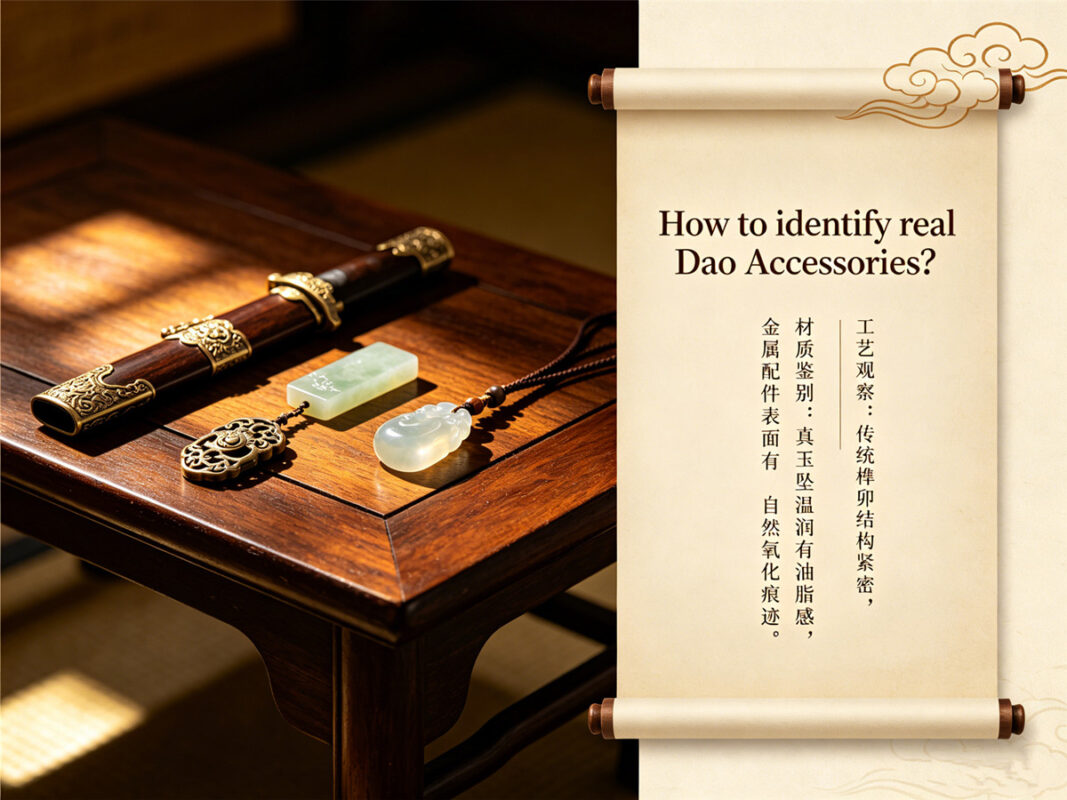
Authentic Dao accessories often incorporate natural or semi-natural materials such as wood, stone, metal alloys, woven fibers, or hand-finished ceramics. These materials tend to have subtle irregularities in texture, weight, or color that signal authenticity and craftsmanship. For example, natural stone beads may have slight variations in tone or surface texture, while handcrafted metal components may show fine tooling marks or gentle asymmetry that indicates human involvement.
In contrast, synthetic materials often appear overly uniform, with perfect repetition and a lack of tactile depth. Plastic-based components, for instance, may feel lighter than expected or have a glossy finish that looks artificial under natural light. While synthetic materials are not inherently low quality, their presence can indicate a more commercial rather than artisanal production process.
Weight, balance, and tactile feedback
Real Dao accessories often have a noticeable sense of balance when held or worn. They are neither excessively heavy nor unnaturally light, and their weight distribution tends to feel intentional rather than accidental. This is particularly important in items such as bracelets, pendants, or hair ornaments, where comfort and wearability are essential.
When an accessory feels uneven, hollow, or overly fragile, it may be a sign of lower-quality construction or shortcut manufacturing techniques.
3. Craftsmanship Details That Reveal Authenticity
Beyond materials, craftsmanship is one of the strongest indicators of whether a Dao accessory is genuine or merely decorative, and careful observation of construction details often reveals more than surface appearance alone.
Hand-finishing versus machine uniformity
One of the most noticeable differences between authentic and imitation Dao accessories lies in finishing techniques. Handcrafted pieces often show subtle variations in engraving depth, brushwork, polishing, or assembly alignment. These variations are not flaws but rather signatures of human involvement, where each piece carries slight individuality.
Machine-produced items, on the other hand, tend to exhibit perfect repetition. While this consistency can be visually appealing, it often lacks the depth and character found in handcrafted work. In many cases, overly uniform detailing can signal mass production rather than artisanal craftsmanship.
Structural integrity and joining methods
Another important detail is how components are assembled. Real Dao accessories typically use secure and thoughtful joining methods, such as tightly bound cords, reinforced metal loops, or carefully soldered connections. These methods are designed not only for durability but also for long-term wear, ensuring that the piece maintains its structure over time.
Loose fittings, weak adhesives, or visible shortcuts in assembly may indicate lower-quality production standards. A well-made accessory should feel stable, with no obvious weak points or fragile joints.
Symbolic coherence in design elements
Authentic Dao-inspired pieces often follow a coherent design language, where decorative elements are not randomly applied but instead arranged with symbolic or aesthetic intention. This might include balanced placement of motifs, consistent thematic patterns, or harmonious integration of shapes and textures.
When decorative elements feel disconnected or overly crowded, it may suggest that the design prioritizes visual impact over meaningful composition.
4. Practical Buying Tips and Recognizing Trusted Sources
Even with knowledge of materials and craftsmanship, identifying real Dao accessories in real-world shopping environments requires attention to sourcing, seller transparency, and product presentation.
Evaluating product descriptions and transparency
One of the simplest yet most effective ways to assess authenticity is by carefully reading product descriptions. Genuine artisans and reputable sellers tend to provide detailed explanations about materials, crafting processes, and design inspiration. They may also acknowledge limitations or variations in handmade items, which reflects honesty in production.
In contrast, vague descriptions filled with generic phrases or overly polished marketing language can sometimes indicate mass-produced items with limited artisanal involvement.
Price as a contextual indicator, not a rule
While price is not an absolute measure of authenticity, it can provide useful context. Extremely low-priced Dao accessories that claim handcrafted quality may warrant closer inspection, as genuine craftsmanship typically involves time, skill, and material costs that are reflected in pricing.
However, higher prices alone do not guarantee authenticity either, especially in commercial markets where branding can inflate value. The key is to evaluate price in combination with materials, craftsmanship, and seller transparency.
Trusted platforms and informed purchasing
Choosing reputable sources can significantly reduce the risk of misidentifying authenticity. Platforms that focus on curated craftsmanship and cultural design tend to offer more consistent quality control and clearer information about product origins.
Many buyers exploring cultural accessories also look for complementary pieces such as Dao gift items or home-oriented Dao decor, which follow similar principles of craftsmanship and symbolic design. These items are often collected not only for aesthetic appeal but also for their cultural meaning and design integrity.
For those interested in exploring thoughtfully made pieces with clearer sourcing and design context, platforms like Daocrafts.com often serve as a reference point for understanding how authentic Dao-inspired accessories are created, presented, and differentiated from mass-produced alternatives, offering insight into how craftsmanship, material honesty, and cultural design principles come together in meaningful ways.